
Updated on 12.06.2026|7:37 PM
Diksha Polymers Limited is set to launch its Initial Public Offering (IPO). It is a Gwalior-based manufacturer of PET bottles, containers, and PET Preforms catering to a diverse B2B clientele.
The public issue will open for subscription on Wednesday, June 17, 2026, and close on Friday, June 19, 2026.
Through this 100% fixed-price fresh issue, the company aims to raise approximately ₹17.90 Crores at a price of ₹112 per share. Track all the IPOs of 2026 at our dedicated latest IPO section.
The proceeds are heavily targeted towards debt repayment to significantly deleverage its balance sheet.
This article covers the latest Diksha Polymers IPO GMP, subscription details, allotment schedule, price band, and a comprehensive review of the issue.
Briefs of Diksha Polymers IPO Details:
- Issue Price: ₹112 per share (Fixed Price)
- Face Value: ₹10 per share
- IPO Open / Close Dates: June 17, 2026 – June 19, 2026
- Lot Size: 1,200 Shares (Note: The minimum application size for retail investors is 2 lots, equivalent to 1,200 shares.)
- Issue Size: 15,98,400 Equity Shares / ~₹17.90 Crores
- Fresh Issue: 100% Fresh Issue
- Registrar: Cameo Corporate Services Limited
- Listing Exchange: NSE EMERGE (SME)
IPO Reservation:
The offering comprises 15,98,400 shares. The allocation is structured as follows:
- NII & QIB Portion (Non-Individual): 7,58,400 Equity Shares (50% of the Net Issue). (Note:Since this is a fixed-price issue, no specific allocation has been reserved for Anchor Investors or QIBs. Applications from institutional and HNI investors are considered within the combined investor pool.).
- Retail (RII) Portion: 7,58,400 Equity Shares (50% of the Net Issue).
How Much is the Diksha Polymers IPO GMP Today? ?
You can track the GMP for this and other stock issues on our main GMP page. You can also check our 25 Mainboard IPOs: GMP vs Actual Listing Performance – A Data Study, to find out listing behaviour of mainboard IPOs with respect to GMP.
This number is unofficial. It is not checked or approved by SEBI, NSE, or BSE. Investors should not make decisions based only on this number.
What Are The Important Diksha Polymers IPO Dates & Allotment Schedule?
The table below outlines the important dates that investors should keep in mind while planning their participation in the issue.
- IPO Open Date: Wednesday, June 17, 2026
- IPO Close Date: Friday, June 19, 2026
- Basis of Allotment Date: Tuesday, June 23, 2026
- Refund Initiation Date: Tuesday, June 23, 2026
- Credit of Shares: Tuesday, June 23, 2026
- Listing Date: Wednesday, June 24, 2026
How does Diksha Polymers Plan to Utilise the IPO proceeds?
The company proposes to utilize the Net Proceeds from the Fresh Issue towards the following strategic purposes:
- Debt Repayment: A highly significant portion of ₹13.75 Crores is earmarked for the repayment or prepayment of existing borrowings. This is a strategic move to drastically reduce the company's Debt-to-Equity ratio and eliminate heavy finance costs, thereby boosting future profitability.
- General Corporate Purposes: The remaining balance of roughly ₹2.25 Crores will be deployed for general corporate needs, providing flexibility to fund strategic initiatives, brand promotion, and meeting ordinary business exigencies.
How is The Financial Performance of Diksha Polymers?
The following table provides an overview of the company's financial performance as reflected in the restated financial statements.
(Figures in ₹ Crores)
Period Ended | FY 2025-26 | FY 2024-25 | FY 2023-24 |
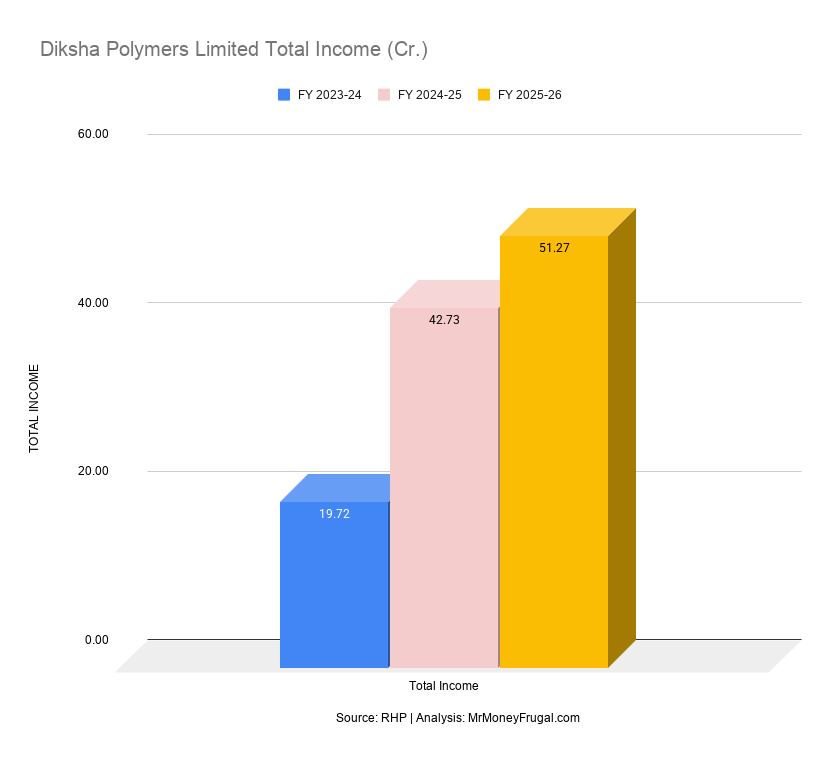
Total Income | 51.27 | 42.73 | 19.72 |
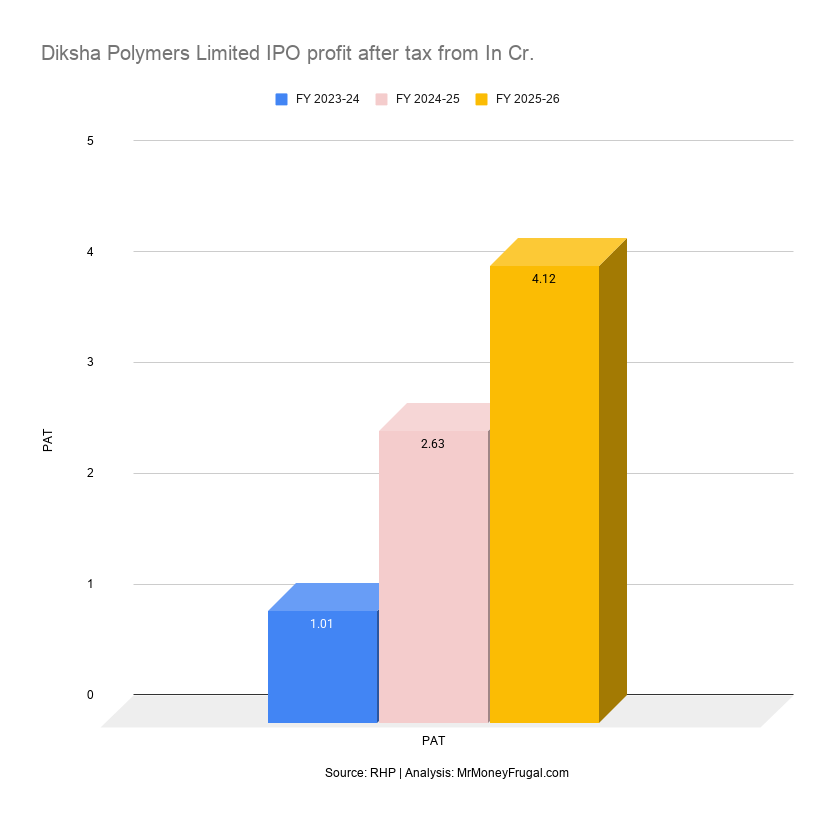
Profit After Tax (PAT) | 4.12 | 2.63 | 1.01 |
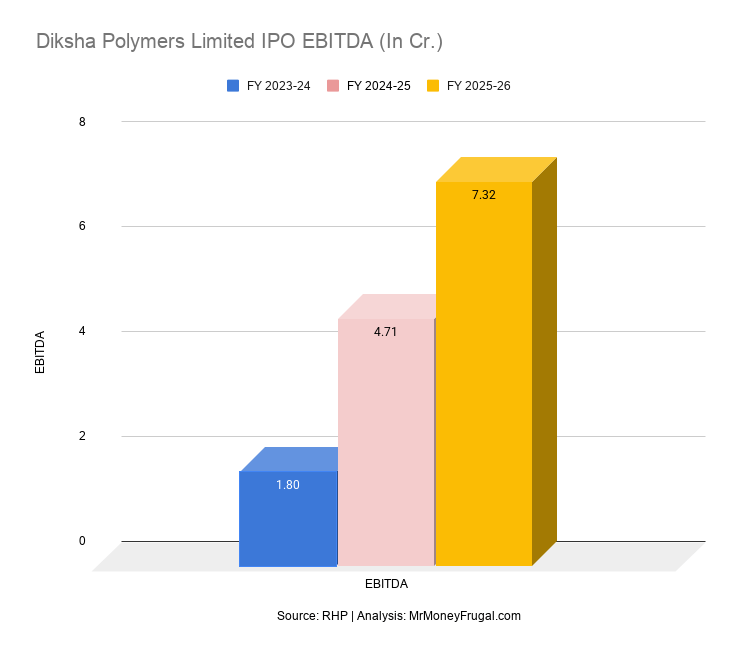
EBITDA | 7.32 | 4.71 | 1.80 |
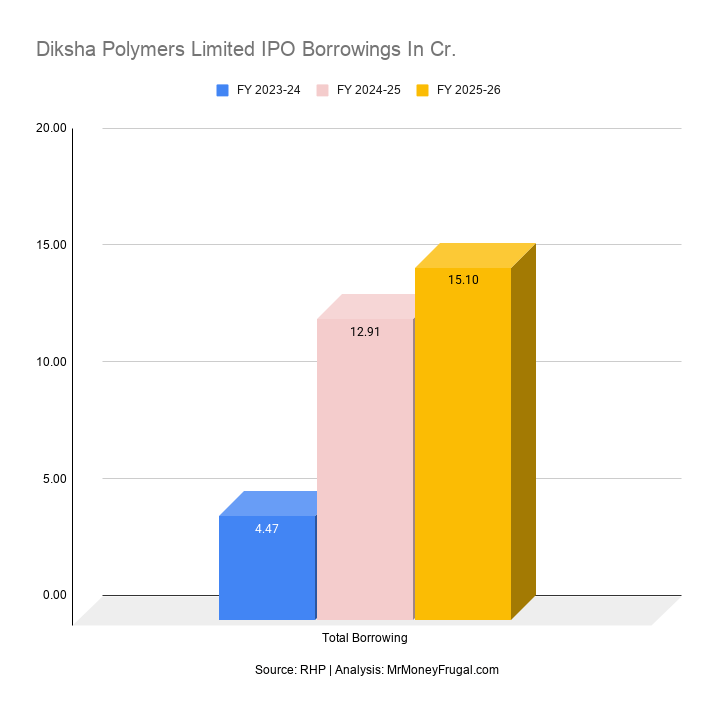
Total Borrowing | 15.10 | 12.91 | 4.47 |
Assets | 28.20 | 25.86 | 6.81 |
Source: RHP
Financial Analysis & Observations:
Total Income:
The company demonstrated exceptional revenue growth, leaping from ₹19.72 Crores in FY24 to ₹51.27 Crores in FY26.
This 61% CAGR scale-up is attributed to the growing regional demand for PET containers and the successful expansion of its in-house production capacity.
Profit After Tax (PAT):
Profitability surged remarkably, from ₹1.01 Crores in FY24 to ₹4.12 Crores in FY26.
This exceptional margin improvement was heavily driven by the backward integration of PET Preforms production following the acquisition of Diksha Packaging, which significantly lowered raw material costs.
EBITDA:
Operational efficiency is strong, with EBITDA expanding from ₹1.80 Crores (9.15% margin) in FY24 to ₹7.32 Crores (14.27% margin) in FY26.
This margin expansion reflects enhanced operational efficiencies and lower transportation costs due to the geographic proximity of its facilities to key markets.
Total Borrowing:
Total borrowings escalated rapidly to ₹15.10 Crores by FY26 to fund aggressive operational expansion, leading to a high Debt-to-Equity ratio of 1.77.
The strategic IPO allocation to repay ₹13.75 Crores of this debt will massively deleverage the balance sheet.
Assets:
The asset base grew exponentially from ₹6.81 Crores in FY24 to ₹28.20 Crores in FY26.
This expansion is predominantly driven by significant increases in trade receivables and inventories required to support the high working capital needs of their rapidly scaling B2B operations.
What Are the P/E Ratio and Peer Comparison?
The valuation can be evaluated using the Price-to-Earnings (P/E) ratio derived from the fixed issue price.
- Issue Price: ₹112
- EPS (FY26): ₹11.44
- P/E Ratio: ~9.79x
Peer Comparison Table (FY 2025-26 Data):
Company | P/E Ratio | RoNW (%) | EPS (₹) | Total Revenue (₹ Lakhs) |
Diksha Polymers | 9.79 | 48.32 | 11.44 | 5,127.34 |
TPL Plastech Limited | 17.36 | 17.21 | 3.73 | 42,255.33 |
Mitsu Chem Plast Ltd | 13.27 | 13.89 | 11.50 | 33,227.84 |
Analysis:
Diksha Polymers is entering the market at a P/E multiple of approximately 9.79x based on its FY26 EPS. When compared to the industry average P/E of 15.32x and listed peers like TPL Plastech (17.36x) and Mitsu Chem Plast (13.27x), the issue appears to be priced at a notable discount.
Furthermore, Diksha boasts a vastly superior Return on Net Worth (RoNW) of 48.32%, significantly outperforming its peers (who hover between 13-17%), indicating highly efficient capital utilization.
This combination of a low valuation multiple and exceptional return ratios makes the pricing look highly attractive.
What is The Industry Outlook of Diksha Polymers?
Growth Potential:
The Indian plastics and packaging industry is experiencing robust tailwinds driven by the fast-moving consumer goods (FMCG), food & beverage, and pharmaceutical sectors. The shift towards lightweight, durable, and recyclable PET packaging is accelerating.
Market Trends:
Regional manufacturing hubs are gaining prominence as companies look to reduce logistics costs and secure supply chains. Integrated players who can manufacture both preforms and final containers are better positioned to capture margins.
What Are The Strengths and Risks of Diksha Polymers IPO?
Strengths:
- High Return Ratios: A stellar RoNW of over 48% and ROCE of 28.09% in FY26 highlight exceptional management of shareholder equity and operational profitability.
- Backward Integration: Producing PET Preforms in-house has structurally improved EBITDA margins and reduced dependency on external suppliers.
- Deleveraging Strategy: Using the vast majority of IPO funds for debt repayment will drastically reduce finance costs and boost net margins post-listing.
Risks:
- Geographic Concentration: Almost 99% of the company's revenue is generated from a single state (Madhya Pradesh), making it highly vulnerable to localized economic or regulatory changes.
- High Concentration Risk: In FY26, the top 10 customers accounted for nearly 89% of total revenue, and the top 10 suppliers accounted for almost 100% of purchases. Loss of any major partner would severely impact the business.
- Negative Cash Flows: Despite high accounting profits, the company reported negative cash flows from operating activities in FY26 due to intensive working capital requirements, specifically surging inventories and trade receivables.
Key Considerations for Investors
Investors should carefully review the minimum investment requirements before applying.
- Minimum Application: Investors are required to apply for a minimum of 2 lots, equivalent to 2,400 shares, since the lot size is 1,200 shares. At the issue price, this translates to an investment of ₹2,68,800. Given that the application amount is above the usual retail investment limit of ₹2 lakh, participation is likely to fall within the Small-HNI segment.
- Valuation vs. Risk: At ~9.8x P/E, the pricing offers a deep discount compared to peers, providing a potential margin of safety against the severe geographic and customer concentration risks.
- Financial Restructuring: The IPO is fundamentally a balance-sheet restructuring exercise. Post-IPO, the debt-to-equity ratio will drop to near zero, which is a strong positive catalyst for the company's financial health.
other Important IPO Resources:
3. IPO Valuation vs Listing Performance Study 2026
4. IPO Listing Performance Tracker 2026 – Complete Dataset of IPO Listing Gains in India
Key Takeaways
- IPO Price: ₹112 per share (Fixed Price).
- Min Investment: ₹2,68,800 (2,400 Shares).
- Valuation: P/E of ~9.79x (Deep Discount to Peers).
- Financials: Revenue ₹51 Cr (FY26); High RoNW (48%).
- Listing: NSE EMERGE platform on June 24, 2026.
FAQs on Diksha Polymers IPO
What is the Latest Grey Market Premium (GMP) for the Diksha Polymers IPO?
You can check gmp at our dedicated gmp today section.
At what price band is the Diksha Polymers IPO being offered??
Each equity share has a fixed issue price of ₹112.
What is Diksha Polymers IPO allotment date?
The planned date to finalise the basis of allotment is Tuesday, June 23, 2026.
Where can applicants verify their Diksha Polymers IPO allotment status?
Investors can check the status on the website of Cameo Corporate Services Limited (the Registrar) or via the NSE IPO allotment portal.
What is Diksha Polymers IPO listing date?
The shares are tentatively scheduled to list on Wednesday, June 24, 2026.
Investment Perspective on Diksha Polymers IPO
Diksha Polymers offers a high-growth opportunity in the plastics packaging sector with exceptional return ratios and an attractive valuation relative to its peers. The clear deleveraging plan is a strong positive. However, the high ticket size for retail investors, combined with extreme geographic and client concentration risks, requires careful consideration before investing.
Disclaimer:
The information presented in this article is for educational purposes only and does not represent investment, financial, or trading advice. Please consult a SEBI-registered investment advisor to assess the suitability of any investment decision.
