
Every stock and SIP portfolio was in RED.
No investor wants to see their portfolio going down. This is one of the lowest moments in their lives. And when it goes down sharply and so fast, even experienced and long-term investors start doubting their strategies and the markets.
But what if it is not only your portfolio, but the market itself is going down—not of one country, but all around the globe?
In such conditions, you feel clueless and don’t know what to do.
And I experienced this during the Covid-19 crash. For a few days, I was also in panic. It looked like the markets would soon collapse and my portfolio would turn to zero.
With the greatest hope, I was repeatedly checking my portfolio many times a day, expecting the fall to stop, but it did not.
If I sell, I will lose all the gains of my 10 years of investing. And if I don’t sell soon, the market will eat it all up.
I was in a dilemma—unsure of what I should do.
And in this detailed post, I will explain everything I encountered during those difficult times and how those moments have made me more experienced and thoughtful about the markets—and what an investor should do during such times.
1. When the World (and Markets) Suddenly Stopped
I had never seen such a level of panic in the markets before Covid-19. If I compare it to the 2008 recession, it felt far worse—at least during those initial days.
Markets were going down not because of weak fundamentals or governance issues, but because of a virus that looked like it could paralyze the entire world.
Markets follow companies and their earnings. But what if there were no humans left to work? Companies would stop automatically. Everything would come to a halt.
No companies, no earnings, and no markets. Everything would turn to dust—or at least that’s how it felt at the time.
No economist could forecast what would happen. Even doctors did not fully understand the virus or how to treat the victims.
It felt like the end of the world.
And this fear was making stocks and markets fall as if they were jumping from a high-rise building.
What March 2020 Felt Like as an Investor
For the time being, it felt like why the hell was I investing in the market at all? Why didn’t I move my investments from mutual funds to FDs or other investment options when Covid first came into the news?
It felt like I was dumb. I started finding faults in myself, and soon it felt like I wasn’t just dumb—but the dumbest.
However, such thoughts are common during extreme market panic, I think, in situations like these.
But one thing I also kept thinking was—this wasn’t about my portfolio or SIP investments. It felt like the world itself was coming to an end.
And even if I had invested in FDs or other fixed assets, I might have lost that too in some form or another.
Companies were closed. People couldn’t go to work. Markets were stopped. Even stepping out of home felt like risking your life.
How Fast the Crash Unfolded
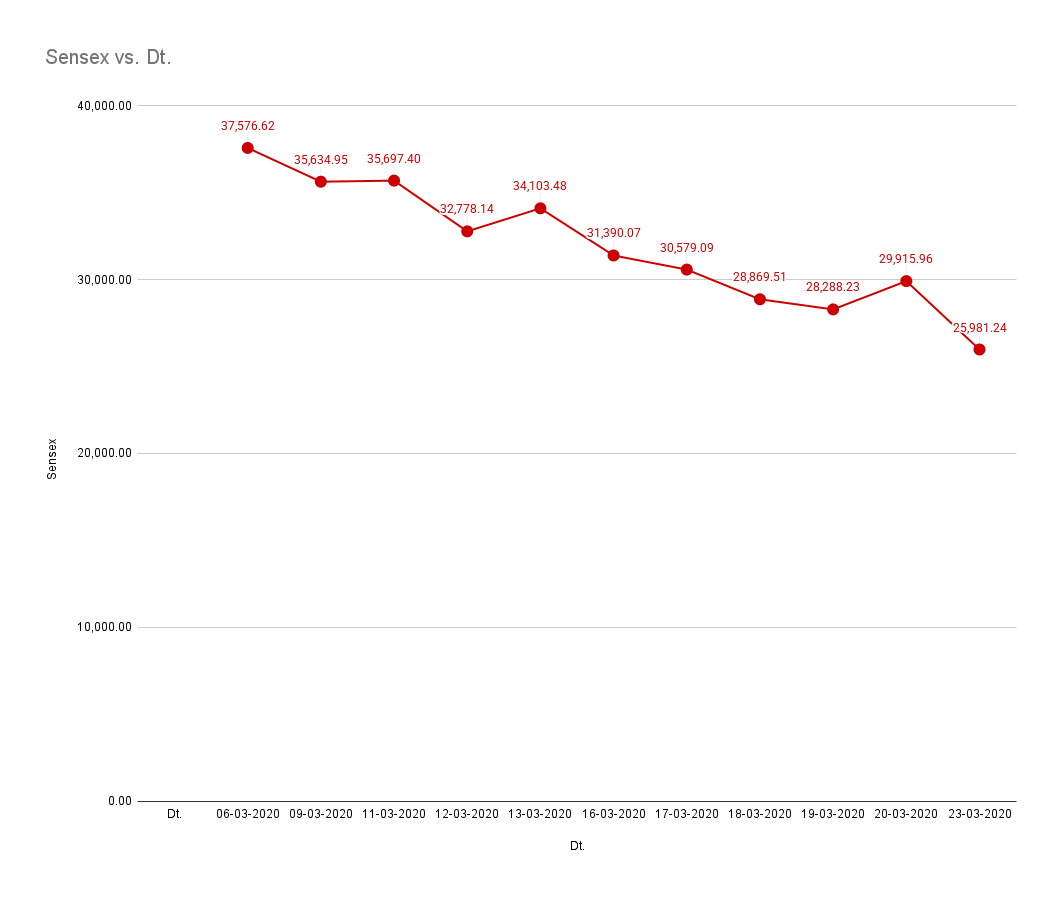
It happened very fast. In just 11 days, the Sensex fell from 37,576.62 to 25,981.24 — a fall of nearly 31% in less than two weeks.
And such crashes are not something you expect or prepare for mentally.
You can look at the graph below and imagine how fast and brutal everything was back then.
Even today, I take a sigh of relief thinking about that phase. I never want to see such a situation again — not even in my worst dreams.
Everything looked bleak.
Should I stay invested or redeem? Nothing felt like the right decision.
And how badly my portfolio was hammered… let me show you that in the next section.
How Fast My Portfolio Got Down
While I cannot exactly feel today what I felt during those days, I clearly remember the disappointment. Losing such a huge amount from my portfolio in less than two weeks was heartbreaking. And I confess it honestly.
I don’t want to show that I am special and tell a different story now. Truly, I felt helpless at that time. It looked like I would lose whatever I had earned over the years.
How will I retire? How will I live the life I had planned?
All those low-moment thoughts started controlling my mind.
But now, let me come to the numbers.
I am starting from 6th March 2020 because from this date onward, the downward trend became faster and more frequent.
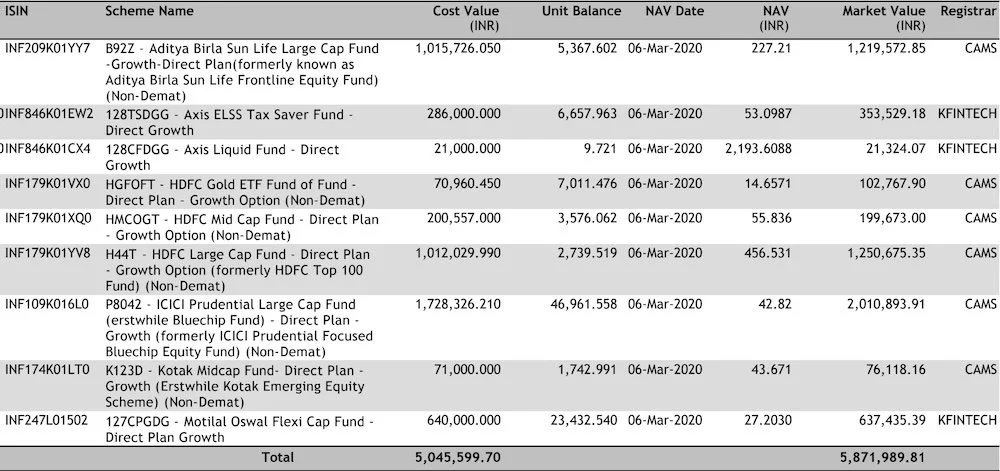
My portfolio value on 06.03.2020: ₹5,871,989.81 My total invested amount on 06.03.2020: ₹5,045,599.70 Difference: +₹826,390
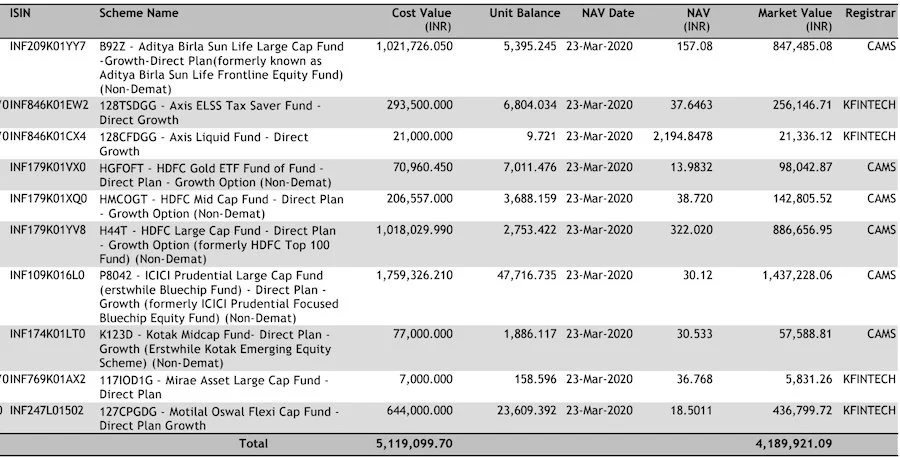
My portfolio value on 23.03.2020: ₹4,189,921.09 Invested amount on 23.03.2020: ₹5,119,099.70 Difference: –₹929,178
How Much My MF Portfolio Fell During the COVID Crash
So, in only 11 trading days, my portfolio moved into a loss of ₹9,29,178, while it was in a profit of ₹8.26 lakh just a few days earlier. It was shocking for me.
In real terms, the portfolio fell by around 29%, and I had no idea what would happen next.
My portfolio was on the verge of wiping out years of gains if things had continued the way they were moving in those 11 days.
In those 11 days, almost all of my 10 years of gains disappeared.
There is no book or lesson that truly prepares you for such market experiences.
I had lived it. I had felt that pain.
And even now, it is difficult to describe that phase in words.
Check the snapshots of my CAMS statement below, before and after the impact. These are from my real account statement. This is not a theory.
It is the life I lived back then.
Why Was This Phase Was Psychologically Difficult?
For days, I did not talk properly with my family. I did not want to tell them that whatever I had earned through my investments had mostly disappeared.
That period was difficult.
And I could not find any clear way out of it.
Nobody had experienced such a situation before, where markets were reacting not because of weak fundamentals, but because the world looked like it might collapse due to a virus.
Businesses were stopped not because they were running in losses, but because of external factors beyond the control of companies as well as governments.
Every newspaper was talking about the downfall, but nobody was clearly talking about a way out of it — what companies, governments, investors, or anyone could actually do in such a situation.
People were not only worried about money anymore.
They were thinking whether they would even live to see the next week.
What I Did Not Do During the Crash: SIP Stopped??
As I already said, during those days it was very difficult to decide whether to continue, stop, or withdraw whatever was left.
If I continued, what if the market kept falling? I would lose what was already invested and whatever more I added.
If I stopped investing, I would lose the opportunity of buying units at such low prices. It was actually a lifetime opportunity to get the same units at nearly 30% lower prices.
If I withdrew, I would not be able to recover what was already lost. The loss would become permanent. I did not want to lose my 10 years of gains.
So, I opted out of withdrawing.
Stopping SIP meant losing a lifetime opportunity of accumulating more units at cheap valuations. So, I opted out of stopping as well.
Continuing looked more logical because somewhere in my mind, I could not accept that the world would collapse completely and everything would come to an end.
And if the world was not ending, things would eventually improve.
And if things improved, markets would regain.
And if markets regained, my portfolio would also recover — and possibly move even higher.
This was the simple logic that worked in my mind.
So, I continued my SIP.
And perhaps this decision helped me cross the ₹1 crore SIP portfolio mark within the year — which I have already shared in my “₹500 to ₹1 Crore SIP” story. You can find more such real life investing stories with real data and experience at our real life investing stories section.
As you saw in the previous section, during those 11 days, I even made a lump sum investment of ₹73,500.
Covid-19 taught me a lesson that no textbook on finance can truly teach.
I learned to analyse calmly, have faith in my strategy and ability, and stick to my investments even during extreme uncertainty.
What If I Had Stopped My SIP? The 5 Lessons That Changed My Investing Forever
If I had stopped my SIPs, I might never have realised my long-term goal of becoming a crorepati and moving towards early retirement.
You can see that within one year of the Covid-19 crash — i.e., on 01.04.2021 — I achieved my goal of ₹1 crore.
However, it took me 11 years of continuous investing to become a crorepati.
One very interesting thing is that Covid-19 came after almost 10 years of my disciplined mutual fund investing (you can learn about mutual funds in our detailed Mutual Fund Learning Hub), and within weeks nearly 30% of my portfolio value evaporated.
But within a year, I regained everything and became a crorepati.
If I had stopped my SIP at that time, I might not have just lost my 10 years of gains temporarily — I might have lost the opportunity to grow wealth faster and move closer to financial independence.
Here are the 5 lessons I learned during Covid-19 that made me a better investor overall:
- Never sell your holdings in a hurry, no matter how conditions turn out nationally or globally.
- When nothing seems to be the right decision, sometimes the best decision is to stay inactive and not touch your portfolio.
- Invest only after proper analysis and when you have full confidence in what you are doing.
- Completely avoid excessive exposure to newspapers or TV personalities during such times. The more you listen, the more confused you may become, and that can impair your decision-making.
- Always keep some money parked elsewhere as an emergency fund so that you are not forced to withdraw your investments during difficult times.
FAQs (For Investors Facing Market Crashes)
Should SIPs be stopped during a market crash?
No, you should not stop SIPs during a market crash. In fact, if you have extra money and your emergency fund is secure, you can even consider doing lump sum investments during such times. Market crashes help you buy more units at lower prices, which reduces your average cost of purchasing over the long term.
What if my portfolio falls 30–40%?
If your portfolio falls 30–40%, you should critically analyse everything. Try to understand the reason behind such a fall. Normally, such falls are possible during pandemics or wars, which are out of anybody’s control.
Is doing nothing really an investing strategy?
Yes, sometimes taking no action is the best strategy. At least you minimize losses that may happen due to wrong decisions taken emotionally.
