
This is an extended version of the story published by me on reddit. The FAQ is designed to answer questions raised on reddit post which got 17k+views, 40 upvotes, and 32 shares.
I could have lost over ₹4.5 lakh—if I had chosen a regular plan instead of a direct plan
The fund name is the same. The portfolio composition is the same. The fund category is the same. The fund manager is the same.
The only difference is that it is not a regular plan, but a direct plan.
I have already explained the difference between direct vs regular plans in much detail in my last post. And here I am going to show one of my personal investments in a mutual fund scheme that is a direct plan, and what would have happened if I had chosen the regular plan instead.
This is not any kind of advice. It is purely my personal experience, based on my real-life investing journey with a mutual fund where I have actually invested my own money.
Why I’m sharing this story
When I started investing in mutual funds, there were no direct plans. I have already shared this in my personal story from a ₹500 SIP to a ₹1 crore portfolio. Back then, I was buying mutual funds through my demat account.
Later, a SEBI circular came — “SEBI Circular No. CIR/IMD/DF/21/2012” — and direct plans were introduced from January 2013.
This is truly one of the best regulations for investors, because the risk is always borne by investors, not by advisors or distributors. And since then, I have never owned any regular plan.
Over time, many things came and disappeared. But after a few years, when I checked the NAV of direct plans and compared it with regular plans, the difference was huge. Then I compared all the schemes in my portfolio.
Direct plans won by a big margin.
The most interesting part is that there is no difference in:
fund composition
fund category
fund manager
benchmark index
Yet, the outcome is very different.
The only difference is the expense ratio. Regular plans have a higher expense ratio because intermediaries like advisors and distributors are paid from it.
As investors, we often don’t bother about the expense ratio. After all, who cares about 1% or 1.5%? It looks negligible.
But when you see the long-term impact of this small difference, your eyes open to how much it actually affects returns.
My Investment In the Fund: The Fund for Comparison
As I already said, whatever I am telling you here or comparing is completely based on my own experience, with a fund where I had my real money invested.
I would also like to make it clear that I do not have any regular plan, so I can’t compare apples to apples. However, I will compare the returns of my direct plan with the regular plan of the same fund, based on historical returns.
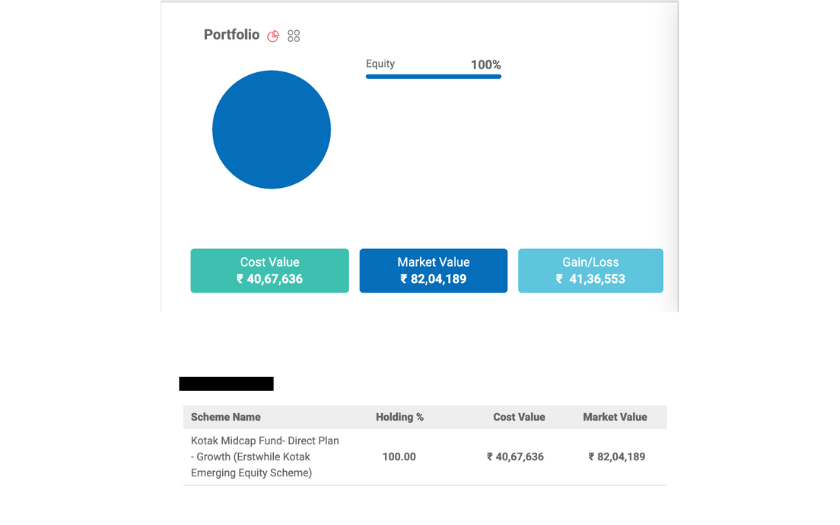
The fund name is: Kotak Midcap Fund
Investment Details
Total investment in the fund: ₹40,67,636
Investment through SIP: ₹16,67,000
Investment through lump sum: ₹24,00,635.57
Date of first investment: 30.10.2018
Value of total investment as on 06.02.2026: ₹82,04,189
Return Comparison
7-year return of regular plan: 20.84%
7-year return of direct plan: 22.27%
Difference in return: 1.43%
So, let us calculate now.
SIP Calculation
The total SIP investment is ₹16,67,000, which comes to approximately ₹19,160 per month. You can use our easy to use SIP calculator to work on these numbers.
With the direct plan, this investment results in ₹25,35,118
With the regular plan, the total value comes out to ₹22,71,239
That is ₹2.63 lakh less in the regular plan compared to the direct plan.
Lump Sum Calculation
Now, if we calculate the lump sum investment (done through staggered investments), the difference again comes to around ₹2 lakh more in favour of the direct plan.
While most of the lump sum investments were made recently, or within the last 2–3 years, still I could have lost over ₹2 lakh to charges of regular plans. Combining both SIP and Lump Sum, it comes out to be 4.63 lakh.
Can you imagine how much this will impact our corpus over the long run?
Long-Term Impact
Let us say I stop investing today and keep my existing investments for the next 15 years.
Principal: ₹82,04,189
With the regular plan, the total value comes out to be: ₹18,19,64,389.99
With the direct plan, the total value comes out to be: ₹22,46,46,052.57
The Difference:
₹4,26,81,663
This is the amount I will lose to the charges of regular plans, while the fund remains the same and the risk remains the same.
Now imagine what happens if I increase the tenure from 15 years to 20 years, 25 years, or 30 years. I will lose even more to the charges of regular plans.
So, why should I make my agent rich, when I take all the risk, and he is just enjoying free money?
I think many people have not realised this truth yet.
This is serious money that we leave on the table by choosing regular plans over direct plans.
Who Should (and Should NOT) Choose Direct Plans
I think if you’re just starting out, the best thing you can do is start with an index fund. Index funds are less expensive, relatively safer than active equity funds, and they help you understand how mutual funds actually work.
You can treat this phase as a learning experience. And if you want to learn more about mutual funds, you can check our Mutual Fund Learning Hub, where we have covered 100+ basic questions on mutual funds that can help you learn faster.
However, if you are already invested in regular plans through an agent, then it is worth asking a few honest questions.
Ask your agent:
Why should you stay invested in regular plans?
How is investing in a regular plan through him better for your portfolio?
What additional value are you getting for the higher expense ratio?
If you don’t get clear and convincing answers, then it is time to make a meaningful decision.
You should also analyse how often you actually need your agent’s guidance. If you rarely depend on him for advice, portfolio review, or hand-holding, then there may be little benefit in continuing with regular plans.
How I Invest Today
As I already said, I don’t invest in mutual funds through regular plans. I have my own portfolio of mutual funds, and for the last 8 years, I have not changed any funds or made any switches.
I believe this is because I have learnt how mutual funds work, and I don’t make decisions in a hurry based on short-term ups and downs of the market.
Anyone can do this if they are willing to learn. It is worth learning about money and how it works, because it helps you make better decisions and keep control over your finances.
I have already mentioned how you can learn about mutual funds in the above section. If you want to learn about new companies entering the market, you can also check our IPO section, where we list all upcoming and live IPOs.
Why am I sharing this story?
This personal experience is not a lead magnet. I am not selling you anything. This is also not investment advice. This is simply what I have experienced.
I could not figure this out initially, but after years of investing, I realised how even small charges can add up to a huge cost over time and reduce our returns. After reading this, you might be thinking the same.
So try to keep charges as low as possible, because this is one of the easiest ways to optimise returns. I unknowingly saved ₹4.63 lakh simply by choosing a direct plan over a regular plan.
Isn’t it?
FAQs:
Is it better to start investing on your own instead of relying fully on an advisor?
I think when you’re starting out, you should begin with an index fund. They are low cost and comparatively safer than equity funds.
Keep learning—how SIPs work, how mutual funds work, and what things you, as an investor, must know to optimise your returns. Treat this phase as a learning experience, and when you feel confident, you can start investing based on your own understanding.
In my personal experience, if someone spends just 10 minutes a day learning about personal finance and investing, they can learn a lot within six months and start making better investment decisions.
Relying solely on advisors is an indirect way of trusting someone else with your money. That’s why I believe it’s important to understand the basics yourself, even if you later choose to take professional help.
Do investors always know whether they are investing in direct or regular mutual fund plans?
I am doubtful that many first-time investors know the difference between regular and direct funds, and how investing in direct plans can earn them more than the regular plans of the same fund. Because of this, many investors may not even realise which type of plan they are holding.
So, if you are reading this, it is worth checking whether your investments are in direct plans or regular plans and understanding the cost difference between the two.
Does choosing a direct mutual fund plan restrict SIP control, like pausing or stepping up investments?
Restrict us? In fact, with direct plans, you usually get more control, not less.
I invest only through direct plans, and in my experience, I find them more convenient. You can start, pause, modify, or step up SIPs just like regular plans, depending on the platform you are using. The flexibility comes from the platform, not from whether the plan is direct or regular.
So choosing a direct plan does not take away control over your SIPs. If anything, it allows you to manage your investments directly without intermediaries.
