
Updated on 14.08.2026
LEAP India Limited is India's largest on-demand asset pooling provider, commanding a near-monopoly with a 90% market share in the supply chain pallet pooling sector.
The company utilizes a circular “share and reuse” business model for pallets, containers, and Material Handling Equipment, boasting a massive network of 14.70 million assets. Track all the Mainboard IPOs at the upcoming and live IPO section.
The LEAP India IPO opens for public subscription on August 7, 2026, and closes on August 11, 2026, with the company aiming to raise ₹2,480 crore through a ₹480 crore fresh issue and a ₹2,000 crore Offer for Sale to fund debt repayment and general corporate purposes.
The price band is fixed at ₹151 to ₹159 per share, requiring a minimum retail bid of 94 shares.
Find all essential LEAP India IPO metrics here, from current GMP and investor subscription rates to the official allotment dates, price limits, and full review.
Briefs of LEAP India IPO Details
- Price Band: ₹151 – ₹159 per share
- IPO Open / Close Dates: 7 August 2026 / 11 August 2026
- Lot Size: 94 shares (Minimum retail investment: ₹14,946)
- Issue Size: ₹2,480.00 crores
- Fresh Issue / OFS: Fresh Issue of ₹480.00 crores / OFS of ₹2,000.00 crores
- Registrar: MUFG Intime India Private Limited
- Listing Exchange: BSE, NSE
IPO Reservation
- Face value: ₹1 per share
- Anchor offer: Up to 60% of the QIB Portion
- QIB-shares: Not more than 50% of the Net Offer
- NIIs-Shares offered: Not less than 15% of the Net Offer
- RIIs- Shares offered: Not less than 35% of the Net Offer
What is Today's Current Grey Market Premium for the LEAP India IPO?
Review this premium alongside other upcoming offerings on our centralized gmp tracker page.
Note: This information is purely an unofficial, demand-driven indicator that is not recognized, monitored, or regularised by SEBI or national stock exchanges.
Check the Important GMP study 25 Mainboard IPOs: GMP vs Actual Listing Performance – A Data Study
Listing Updates:
| Metric | Value |
| Issue Price | ₹159 |
| Listing Price | ₹165.90 |
| Listing Gain/Loss | 4.34% |
| Final GMP | ₹13 |
| GMP % | 8.18% |
| Lowest GMP | ₹3 |
| Highest GMP | ₹19 |
| GMP vs Listing | Below Expectations |
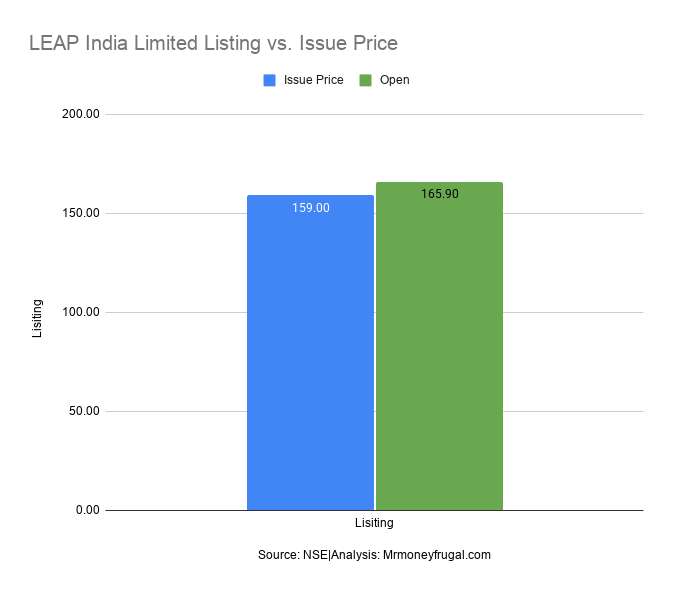
LEAP India IPO: Issue Price vs Listing Price
What is the Official Subscription Timeline and Allotment Schedule for the LEAP India IPO?
- IPO Open & Close Date: 7 August 2026 to 11 August 2026
- Basis of Allotment Date: 12 August 2026
- Refund Initiation Date: 13 August 2026
- Credit of Shares: 13 August 2026
- Listing Date: 14 August 2026
What are the Primary Funding Destinations and Core Goals Behind the LEAP India IPO?
The corporate leadership plans to utilize the net capital raised from this fresh share issuance for the following primary purposes:
- Debt Repayment: Approximately ₹360.00 crores will be utilised to repay or prepay outstanding borrowings to ease the company's leverage.
- General Corporate Purposes: The company will use the residual balance—not exceeding 25% of gross capital—for business expansion plans, asset investments, and general corporate contingencies. (Note: The company will not receive any proceeds from the ₹2,000.00 crore Offer for Sale component).
Check this important tracker IPO Listing Performance Tracker 2026 – Complete Dataset of IPO Listing Gains in India
What do the Historical Financial Statements and Accounting Records Reveal about LEAP India?
The following data presents a summarized view of LEAP India's official financial performance, denominated in Crore Rupees.
Period Ended | 31 Mar 26 | 31 Mar 2025 | 31 Mar 24 |
Total Income | 747.36 | 485.03 | 371.94 |
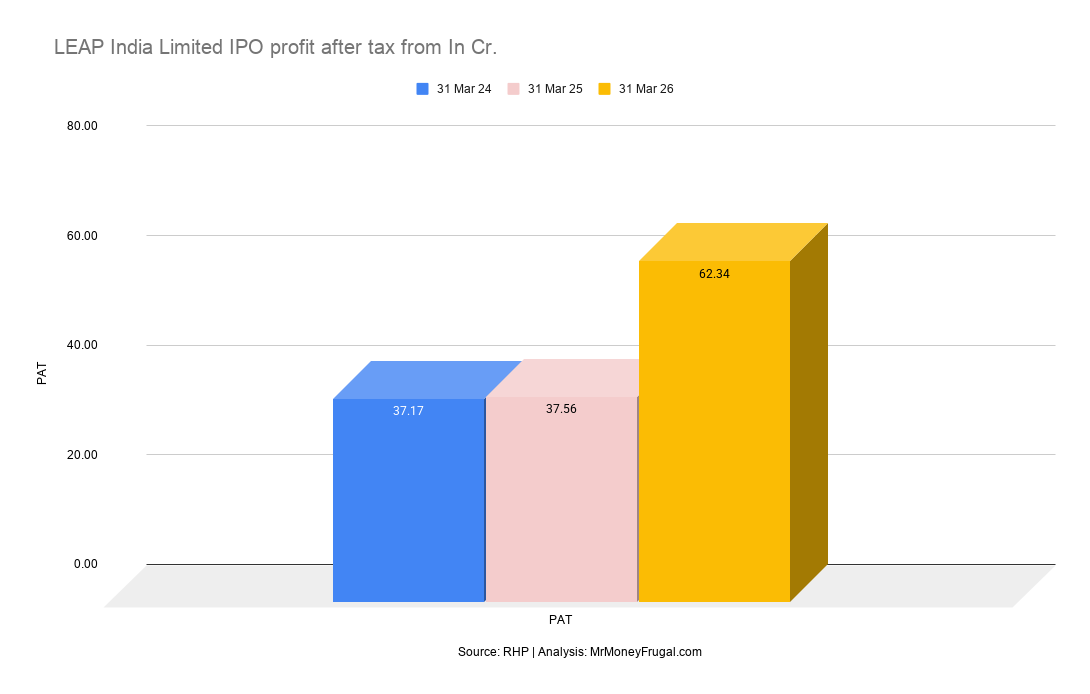
Profit After Tax | 62.34 | 37.56 | 37.17 |
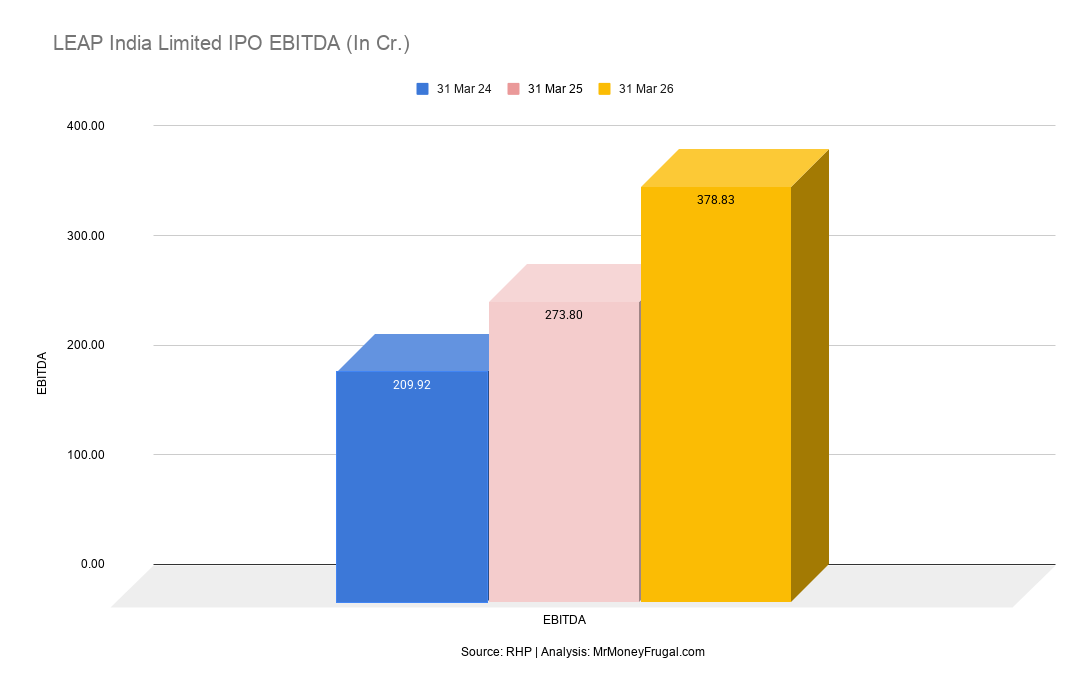
EBITDA | 378.83 | 273.80 | 209.92 |
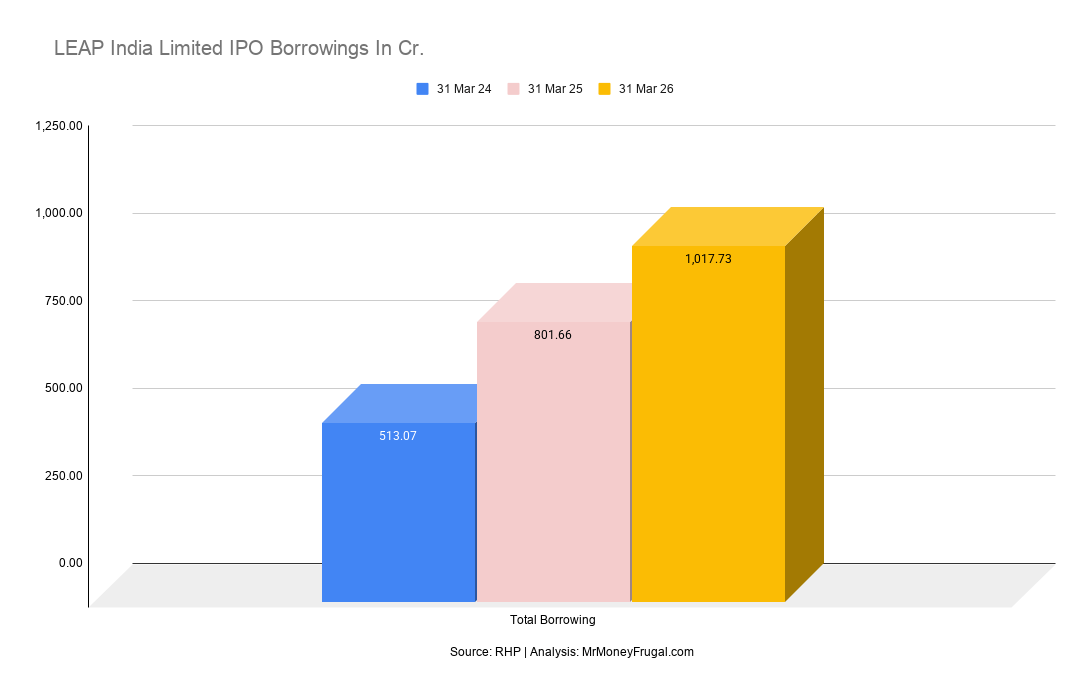
Total Borrowing | 1,017.73 | 801.66 | 513.07 |
Assets | 2,401.05 | 2,042.46 | 1,400.28 |
Source: RHP
Financial Observations
Total Income
The company has demonstrated robust top-line growth over the last three fiscal years.
- Revenue grew from ₹371.94 crores in FY24 to ₹747.36 crores in FY26.
- This impressive surge was driven by the expansion of its blue-chip customer base.
- The strategic acquisition of CHEP India in January 2025 further solidified its market leadership.
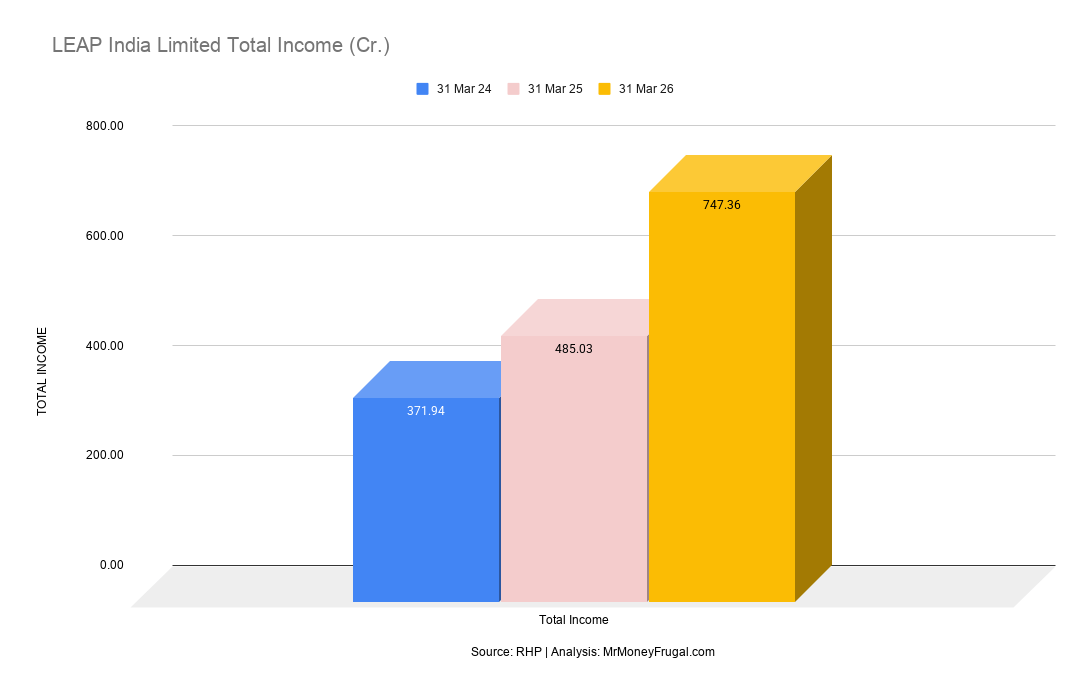
Profit After Tax
Net profitability expanded sequentially as the company scaled its asset pooling operations.
- PAT increased from ₹37.17 crores in FY24 to ₹62.34 crores in FY26.
- High operating leverage and zero customer churn among top clients supported this growth.
- Heavy depreciation from expanding physical assets kept bottom-line growth moderate relative to revenues.
EBITDA
Operational earnings grew substantially due to excellent asset utilisation rates.
- EBITDA rose sharply from ₹209.92 crores in FY24 to ₹378.83 crores in FY26.
- The company maintained a stellar EBITDA margin of 50.69% in the latest fiscal year.
- A massive network of fulfilment centres ensures cost-efficient logistics and margin protection.
Total Borrowing
The business heavily utilises external debt to finance its capital-intensive asset base.
- Total borrowings surged from ₹513.07 crores in FY24 to ₹1,017.73 crores in FY26.
- This debt accumulation resulted in a Debt-to-Equity ratio of 1.01x in FY26.
- The IPO's fresh issue designates ₹360 crores specifically for debt repayment to ease this leverage.
Assets
The overall resource base of the company widened to accommodate its rapidly expanding logistics network.
- Total assets expanded significantly from ₹1,400.28 crores in FY24 to ₹2,401.05 crores in FY26.
- This steady build-up reflects continuous capital deployment to acquire millions of pallets, containers, and material handling equipment.
- Strategic acquisitions, including CHEP India, also contributed heavily to this massive physical asset footprint.
What Are The P/E ratio and Peer Comparison LEAP India IPO ?
LEAP India Limited's P/E valuation stands at 104.61, determined by dividing the top of the price range (₹159) by the reported FY26 EPS of ₹1.52.
LEAP India Limited occupies a highly specialized and unique position in the supply chain logistics sector. The company's prospectus explicitly states that there are no listed comparable companies in India or globally that match its specific business model and scale of operations.
Because of this lack of listed domestic or global peers, traditional financial benchmarking against industry standards (such as P/E or market capitalization multiples) is not possible.
However, from an operational perspective, the global pallet pooling market is highly consolidated and functions as an oligopoly or duopoly in most developed regions. Leading global giants dominate their respective geographies through massive scale, technological integration, and high barriers to entry.
To understand LEAP India's operational scale and competitive environment, we can compare it against these dominant international players, such as CHEP (Brambles), LOSCAM, and LPR (La Palette Rouge).
Below is an overview comparing LEAP India against these key global asset pooling providers:
Global Pallet Pooling Peers | Focus Geography | Units in Circulation | Revenue FY 2024 (in USD million) | Revenue FY 2026 (in USD million) |
CHEP (Brambles) | North America, Europe, ANZ, GCC | Over 354 million | 6,480 | 6,930 |
LPR (La Palette Rouge) | Western Europe, | Over 46 million | 440 | 480 |
LOSCAM | APAC (China, ANZ), | Over 80 million | 335 | 365 |
LEAP India | India | Over 14.70 million | 44.6 | 78.9 |
Analysis:
According to the Red Herring Prospectus, there are no listed comparable companies in India or globally that perfectly match LEAP India's specific business model and operational scale.
Consequently, traditional domestic peer benchmarking is not possible.
Evaluated against global operational peers like CHEP (Brambles) and LPR, LEAP operates on a much smaller absolute revenue base.
However, at the upper price band, LEAP India enters the primary market demanding an implied P/E multiple of approximately 104.61x.
This steep valuation multiple reflects the market's high growth expectations for a company that commands a standalone 90% monopoly in the rapidly formalising Indian pallet pooling industry.
What is The Industry Outlook of LEAP India Limited?
Growth potential
- India's rapid industrialisation and booming e-commerce sectors present massive long-term structural tailwinds for organised supply chain logistics.
- The shift from unorganised, fragmented logistics to standardised, tech-enabled asset pooling offers a massive runway for volume growth.
- A growing corporate emphasis on sustainable, circular "share and reuse" business models is driving the widespread adoption of pallet pooling.
Market trends
- The supply chain asset pooling industry is highly capital intensive, naturally evolving into regional monopolies or oligopolies with high barriers to entry.
- Blue-chip FMCG and manufacturing corporations increasingly prefer outsourcing logistics hardware to avoid disruptive supply chain re-palletization.
- Consolidation is a major trend, as leading players acquire smaller regional operators to expand their distribution networks and touchpoints rapidly.
What Are The Strengths and Risks of LEAP India IPO ?
Strengths:
- High Barriers to Entry: The industry is incredibly capital intensive and demands a vast pan-India distribution network, acting as a massive competitive moat against new entrants.
- Sticky Customer Base: Re-palletization is highly disruptive for businesses, leading to high switching costs. Consequently, LEAP enjoys a 0.00% churn rate among its top 100 blue-chip clients.
- High Operating Leverage: Excellent asset utilisation rates (89.34% for pallets in FY26) allow the firm to maintain incredibly robust EBITDA margins above 50%.
Risks:
- Product Concentration: A significant 62.17% of FY26 operational revenue is derived solely from the pallet pooling business, making the firm vulnerable to segment-specific disruptions.
- Capital Intensity and Debt: Heavy borrowing is required to fund asset growth, resulting in total debt of ₹1,017.73 crores in FY26 and a Debt-to-Equity ratio of 1.01x.
- Asset Maintenance: The company faces high ongoing repair and maintenance costs (₹39.82 crores in FY26) alongside persistent impairment losses from assets damaged by customers.
Key Considerations for Investors
- Near-Monopoly Position: LEAP holds an unparalleled 90% market share in India's pallet pooling sector, supported by a 0% churn rate among its top 100 blue-chip clients.
- High Debt Levels: The capital-intensive nature of asset pooling resulted in total borrowings of ₹1,017.73 crores in FY26, yielding a 1.01x Debt-to-Equity ratio.
- Valuation Premium: At the upper band, the company demands an implied P/E multiple of ~104.61x, reflecting steep growth expectations without any listed domestic peers for comparison.
- Product Concentration: The business remains vulnerable to segment-specific disruptions, as 62.17% of FY26 revenue originates solely from pallet pooling.
Important IPO Resources
2. IPO Allotment Status – How to Check Allotment Status of IPO Shares
3. Latest IPO Subscription Status Today | Live Updates
4. July 2026 IPO Review: 33 IPOs, ₹21140.52 Cr Raised & 56.37x Average Subscription
Key Takeaways
- IPO Price Band: ₹151 to ₹159 per equity share
- Lot Size: 94 shares (Minimum retail investment of ₹14,946)
- Allotment Date: Allotment on 12 August 2026
- Listing Dates: Listing on BSE and NSE on 14 August 2026
FAQs on LEAP India IPO
Where does the LEAP India IPO GMP currently stand today?
Monitor current premium adjustments for this mainboard IPO on our central hub page, noting that unofficial indicators fluctuate daily according to changing market demand.
What is LEAP India IPO price band?
The price band has been fixed at ₹151 to ₹159 per equity share.
What is LEAP India IPO allotment date?
The basis of allotment is scheduled to be finalised on 12 August 2026.
How to check LEAP India IPO allotment status?
After the share allocation process concludes, market participants can review their allotment on the online portal of the registrar, MUFG Intime India Private Limited, by providing their PAN or application number.
What is LEAP India IPO listing date?
The equity shares are proposed to be listed on the BSE and NSE platforms on 14 August 2026.
Investment Perspective on LEAP India IPO
LEAP India’s IPO presents an opportunity to invest in a near-monopoly commanding a 90% market share in India's pallet pooling industry.
The company boasts robust financial growth, reporting a net profit of ₹62.34 crores and an impressive 50.69% EBITDA margin in FY26.
However, prospective investors must carefully weigh these strengths against significant risks, notably its heavy debt burden of ₹1,017.73 crores and an absolute lack of any listed comparable peers.
Disclaimer:
This note functions exclusively as broad market commentary rather than tailored asset management advice. Readers should seek guidance from an accredited SEBI investment professional before initiating market trades.
