
Madhur Knit Crafts Limited operates as an established textile manufacturer in Ludhiana, Punjab, featuring a fully vertically integrated "yarn-to-cloth" business model.
The company produces various knitted fabrics, garments, and blankets for apparel and industrial uses.
Transitioning to the public markets, the Madhur Knit Crafts IPO opens for public subscription on August 24, 2026, and closes on August 27, 2026.
The enterprise aims to raise up to ₹53.28 crores via a fresh issue of 53,27,693 equity shares on the NSE Emerge platform to fund solar infrastructure and working capital. The price band is fixed at ₹95 to ₹100 per equity share, requiring a minimum retail bidding lot of 2,400 shares.
Investors can use this article to track key details of the Madhur Knit Crafts IPO, including today's grey market premium (GMP), subscription demand, price band, and the expected allotment timeline.
Briefs of Madhur Knit Crafts IPO Details
- Price Band: ₹95 – ₹100 per share
- IPO Open / Close Dates: 24 August 2026 / 27 August 2026
- Lot Size: 1,200 shares (Minimum retail application of ₹2,40,000 for 2 lots)
- Issue Size: 53,27,693 shares / Up to ₹53.28 crores
- Fresh Issue / OFS: Fresh Issue of 53,27,693 shares / OFS: Nil
- Registrar: Skyline Financial Services Pvt. Ltd.
- Listing Exchange: NSE Emerge
IPO Reservation
- Face value: ₹10 per share
- Anchor offer: Up to 60% of the QIB Portion
- QIB-shares: Not more than 50% of the Net Issue
- NIIs-Shares offered: Not less than 15% of the Net Issue
- RIIs- Shares offered: Not less than 35% of the Net Issue
What is Today’s Grey Market Premium (GMP) Valuation for the Madhur Knit Crafts IPO?
Visit our centralized hub to view current and upcoming IPO grey market premiums.
Please note that GMP fluctuates daily according to investor interest and functions as an informal metric outside the regulatory oversight of SEBI, BSE, and NSE.
What are the Key Timeline Dates Investors need to know for the Madhur Knit Crafts IPO?
- IPO Open & Close Date: 24 August 2026 to 27 August 2026
- Basis of Allotment Date: 28 August 2026
- Refund Initiation Date: 31 August 2026
- Credit of Shares: 31 August 2026
- Listing Date: 1 September 2026
What are the Stated Corporate Objectives for the Madhur Knit Crafts Public Offering?
The company management intends to deploy the net proceeds from the fresh issue for the following core objectives:
- Debt Repayment: An allocation of ₹20.85 crores is designated to prepay or repay a portion of its outstanding bank debt, significantly lowering the interest burden.
- Working Capital Requirements: ₹15.91 crores will be utilised to support day-to-day operations and prevent cash-flow bottlenecks inherent in the vertically integrated textile model.
- Rooftop Solar CAPEX: ₹3.67 crores is earmarked to set up a 1,500 KW on-grid rooftop solar power plant, cutting utility grid energy dependence by nearly 47%.
- General Corporate Purposes: Any unallocated balance will fund long-term strategic initiatives alongside standard administrative and operating needs.
What are the Key Highlights of Madhur Knit Crafts' Financial Track Record?
A summary of Madhur Knit Crafts’s reported financial data is detailed below in Indian Rupees (in Crores).
Period Ended | 28 Feb 2026 | 31 Mar 2025 | 31 Mar 2024 | 31 Mar 2023 |
Total Income | 19.48 | 17.18 | 10.84 | 8.96 |
Profit After Tax | 12.35 | 11.03 | 1.70 | 0.90 |
EBITDA | 25.68 | 23.28 | 8.04 | 5.51 |
Total Borrowing | 73.54 | 67.20 | 57.79 | 34.18 |
Assets | 159.97 | 122.59 | 90.60 | 64.59 |
Financial Observations
Total Income
The company registered a highly aggressive upward trajectory in its revenue streams over the observed fiscal periods.
- Total income expanded from ₹8.96 crores in FY23 to ₹19.48 crores in the 11-month stub period ending Feb 2026.
- This dramatic acceleration is primarily due to a strategic shift towards higher-value knitted cloth manufacturing.
- The transition to a fully integrated yarn-to-cloth model enabled the firm to handle significantly higher sales volumes.
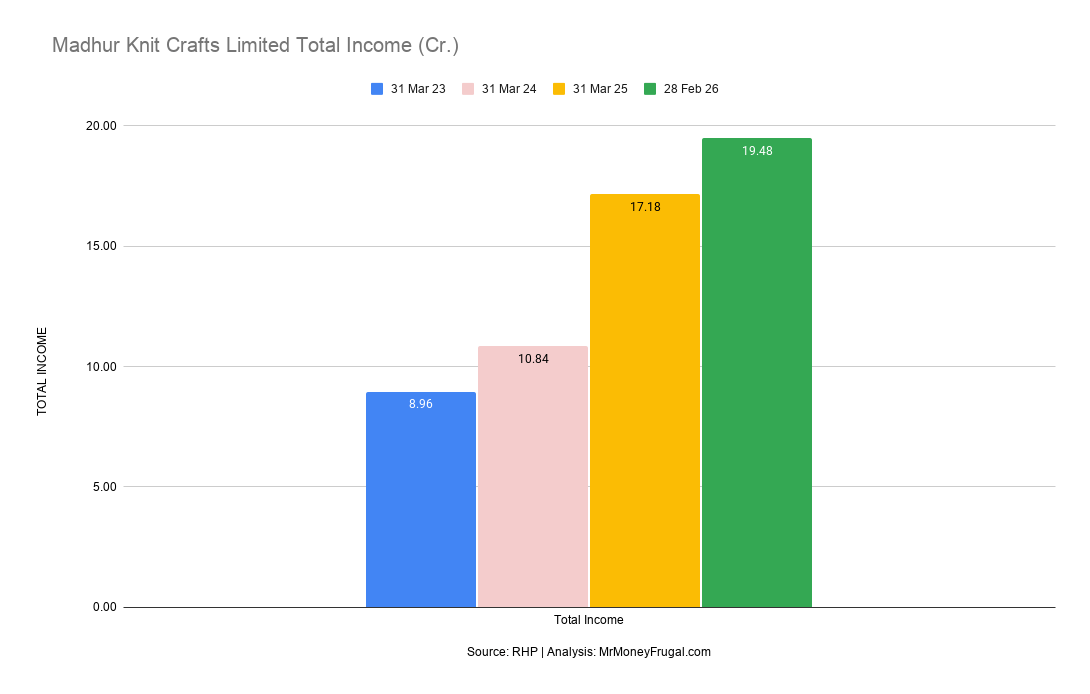
Madhur Knit Crafts Total Income, FY23–Feb 2026 (₹ crore)
Profit After Tax
Net profitability experienced exponential multi-fold growth as operational capabilities and scale widened.
- PAT surged massively from ₹0.90 crores in FY23 to ₹12.35 crores in the 11-month stub period ending Feb 2026.
- The bottom-line performance reflects strong operational leverage following extensive capital asset additions in prior years.
- A notable drop in total expenses as a percentage of revenue demonstrated excellent administrative overhead control.
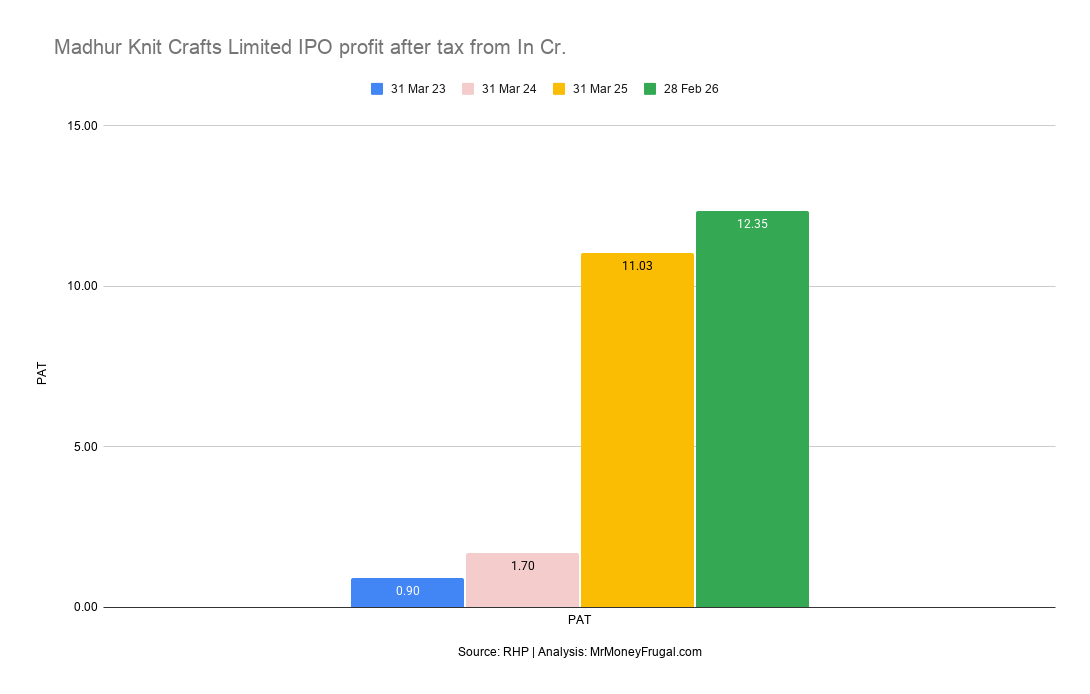
Madhur Knit Crafts Profit After Tax, FY23–Feb 2026 (₹ crore)
EBITDA
The expansion of the firm's vertically integrated model led to a substantial upward trajectory in its main operational earnings.
- EBITDA jumped from ₹5.51 crores in FY23 to ₹25.68 crores in the Feb 2026 stub period.
- The EBITDA margin doubled, expanding from 6.17% in FY23 to a highly competitive 13.19% recently.
- Capturing the full manufacturing value chain from yarn processing to finished fabric added direct gross margin benefits.

Madhur Knit Crafts EBITDA, FY23–Feb 2026 (₹ crore)
Total Borrowing
The business aggressively utilised external debt to finance its capital-intensive manufacturing expansions.
- Total borrowings rose sequentially from ₹34.18 crores in FY23 to ₹73.54 crores by February 2026.
- This heavy leverage resulted in elevated finance costs that have dragged down net margins historically.
- A major portion of the IPO fresh issue proceeds (₹20.85 crores) is specifically dedicated to easing this outstanding financial burden.

Madhur Knit Crafts Total Borrowing, FY23–Feb 2026 (₹ crore)
Assets
The overall resource base of the company widened to accommodate continuous investments in physical infrastructure.
- Total assets grew dramatically from ₹64.59 crores in FY23 to ₹159.97 crores by Feb 2026.
- This expansion reflects the deployment of capital into tangible Property, Plant & Equipment to support end-to-end manufacturing.
- High working capital intensity also inflated the asset base, specifically through rising inventories and trade receivables.
What Are the P/E ratio and Peer Comparison of Madhur Knit Crafts Limited?
Using the ceiling price of ₹100 and the FY25 EPS of ₹8.51, the calculated price-to-earnings multiple for Madhur Knit Crafts Limited is 11.75x.
It should be noted that the core financial indicators correspond to FY25 for Madhur Knit Crafts and FY26 for Kaytex Fabrics.
Name of the Company | Revenue from Operations (₹ Cr) | Face Value (₹) | Basic EPS (₹) | P/E Ratio | RoNW (%) | NAV (₹) |
Madhur Knit Crafts Ltd | 171.64 | 10 | 8.51 | 11.75 | 37.42 | 22.31 |
Kaytex Fabrics Ltd | 162.83 | 10 | 12.79 | 4.69 | 14.96 | 79.27 |
Analysis:
Madhur Knit Crafts Limited enters the primary market demanding an implied P/E multiple of approximately 11.75x at the upper price band.
When evaluated against its sole listed industry peer, Kaytex Fabrics, which trades at a highly conservative P/E of 4.69x, the issue appears priced at a premium.
However, operating on a comparable revenue base (₹171.64 crores in FY25), Madhur boasts an exceptional Return on Net Worth (RoNW) of 37.42%, drastically outperforming Kaytex Fabrics' 14.96%.
This premium reflects the firm's successful vertical integration, which provides robust margin retention and highly efficient capital utilisation compared to conventional textile players.
What is the Industry Outlook of Madhur Knit Crafts Limited?
Growth potential
- The Indian textile and apparel sector is undergoing robust expansion, driven by strong domestic consumption and increasing disposable incomes across Tier-2 and Tier-3 cities.
- The shift towards technical textiles and specialised knitted fabrics provides high-margin growth avenues for vertically integrated manufacturers.
- Government incentives, such as the PLI (Production Linked Incentive) scheme, are encouraging textile firms to scale up manufacturing capacities and enhance export competitiveness.
Market trends
- The textile manufacturing space remains highly fragmented and working-capital intensive; managing inventory efficiently through demand-driven order books is critical to protecting margins.
- Sustainability is a growing trend, with companies increasingly investing in captive renewable energy sources (like rooftop solar) to offset the high power costs associated with yarn processing and dyeing.
- Geographical hubs, such as Ludhiana in Punjab, continue to dominate the knitwear segment, though this creates regional supply chain dependencies for local manufacturers.
What Are The Strengths and Risks of Madhur Knit Crafts IPO ?
Strengths:
- Vertical Integration: Transitioning from simple job processing to a fully integrated "yarn-to-cloth" manufacturer has doubled EBITDA margins (from 6.17% in FY23 to 13.56% in FY25).
- Superior Return Metrics: The business generates an exceptional Return on Net Worth (RoNW) of 37.42% in FY25, significantly outpacing its listed peer.
- Cost Reduction via Solar: Allocating IPO funds to set up a 1,500 KW rooftop solar plant will cut grid power dependence by nearly 47%, offering a rapid 2.46-year payback period.
Risks:
- Geographical Concentration: The company derives over 98% of its total revenue from Punjab, and 99.26% of raw materials are sourced from the same state, exposing it to extreme regional risks.
- High Debt Levels: Total borrowings reached ₹73.54 crores by February 2026 to fund extensive capacity expansions, resulting in an elevated debt-to-equity ratio of 1.69x.
- Working Capital Strain: The business is working-capital intensive, with a long cash conversion cycle of 153 days and inventory holding days stretching to 147 days.
Key Considerations for Investors
- Debt Reduction Plan: The company is heavily leveraged with ₹73.54 crores in borrowings; however, ₹20.85 crores from the IPO proceeds are specifically designated to retire debt and lower finance costs.
- Geographical Exposure: With over 98% of revenue and 99.26% of raw material sourcing concentrated in Punjab, the firm is highly vulnerable to localised disruptions.
- Working Capital Intensity: The "yarn-to-cloth" model demands heavy stockpiling, stretching inventory holding to 147 days and the cash conversion cycle to 153 days.
- Margin Expansion: Vertical integration successfully doubled the EBITDA margin to 13.56% in FY25, allowing the business to post a stellar 37.42% Return on Net Worth.
Related IPO Resources
2. IPO Allotment Status – How to Check Allotment Status of IPO Shares
4. GMP vs Listing Gains July 2026 IPOs: A Data Analysis of 34 IPOs
5. July 2026 IPO Subscription Review: 32 IPOs Data, Demand Patterns & Key Trends
6. GMP vs Listing Gains July 2026 IPOs: A Data Analysis of 34 IPOs
Key Takeaways
- IPO Price Band: ₹95 to ₹100 per equity share
- Lot Size: 1,200 shares (Minimum retail application of ₹2,40,000 for 2 lots)
- Allotment Date: Allotment on 28 August 2026
- Listing Date: Listing on NSE Emerge on 1 September 2026
FAQs on Madhur Knit Crafts IPO
You can find the latest GMP updates for this SME issue on our dedicated GMP hub page, as unofficial premium indicators change daily based on market sentiment.
The official price boundaries are fixed at ₹95 (floor price) and ₹100 (cap price) per share.
The finalization of the allotment basis is officially scheduled to take place on August 28, 2026.
Investors can review their final share allocation by accessing the official platform of the registrar, Skyline Financial Services Pvt. Ltd., and inputting their PAN or application credentials.
The equity shares are proposed to be listed on the NSE Emerge platform on 1 September 2026.
Madhur Knit Crafts Limited demonstrates impressive operational scaling, with revenue reaching ₹17,163.50 lakhs in FY25 driven by its transition to an integrated yarn-to-cloth model.
While vertical integration has successfully boosted EBITDA and PAT margins, several structural concerns still remain.
Prospective investors must carefully weigh these strong margins against a heavy debt burden, historical negative operating cash flows, and extreme regional concentration, as the firm relies on Punjab for over 94% of its total customer revenue, presenting a distinct geographic vulnerability.
Useful Links: Madhur Knit Crafts RHP
Disclaimer: This information is intended for educational purposes only and does not constitute formal financial advice. Investors should consult a SEBI-registered investment advisor before making any financial commitments.
