
Manipal Health Enterprises Limited made a positive debut on the BSE and NSE, listing at ₹652 against its issue price of ₹590, delivering a 10.51% listing gain to IPO investors.
The listing was particularly notable because pre-listing indicators had remained weak. The IPO received an overall subscription of only 2.65x, while Retail and NII portions remained undersubscribed at 0.75x and 0.89x, respectively.
Grey market sentiment had weakened even more dramatically. The GMP started at ₹55, subsequently fell into negative territory and touched -₹15, before recovering to just ₹7 ahead of listing. The final GMP implied a premium of only around 1.19% over the issue price.
So, despite a modest 2.65x subscription and a final GMP implying just 1.19% upside, Manipal Health eventually listed at a 10.51% premium. What explains this divergence?
Before diving into the analysis, you can also read our Manipal Health Enterprises IPO Review for a detailed assessment of the company's financials, valuation, strengths, risks and IPO details.
Listing Snapshot — Manipal Health Enterprises
| Particular | Details |
|---|---|
| Issue Price | ₹590 |
| Listing Price | ₹652 |
| Listing Gain | 10.51% |
| Last GMP | ₹7 |
| GMP-implied Premium | 1.19% |
| Listed Above GMP Expectations | Yes |
| Overall Subscription | 2.65x |
| QIB Subscription | 4.19x |
| NII Subscription | 0.89x |
| RII Subscription | 0.75x |
| Employee Subscription | 1.84x |
Looking for other public issues? Visit our Latest IPOs page to track upcoming, ongoing and recently listed IPOs.
Weak Subscription and Falling GMP Pointed to Cautious Sentiment
Investor demand for Manipal Health remained subdued through most of the subscription period. The IPO was subscribed just 0.12x on Day 1 and 0.40x on Day 2, before improving sharply on the final day to close at 2.65x.
The category-wise numbers showed that this demand was largely driven by institutions. QIB subscription reached 4.19x, while NIIs at 0.89x and Retail Investors at 0.75x remained undersubscribed. Employee participation stood at 1.84x.
Grey market sentiment weakened even more dramatically. GMP started at ₹55, gradually declined to ₹0 and eventually turned negative, touching a low of -₹15. It recovered towards the end but finished at only ₹7, implying around 1.19% upside over the ₹590 issue price.
The listing therefore produced a clear divergence from both pre-listing indicators. Despite only 2.65x overall subscription and a final GMP of just ₹7, Manipal Health opened at ₹652, delivering a 10.51% premium.
For the latest grey market updates across active IPOs, visit our IPO GMP Today page. You can also track QIB, NII and retail demand through our Day-wise IPO Subscription Status page.
Strong Revenue and EBITDA Growth, but PAT and Debt Need Context
Manipal Health entered the IPO after significant business expansion. Total Income increased from ₹6,265.17 crore in FY24 to ₹10,520.52 crore in FY26, representing growth of nearly 68% in two years, supported by acquisitions of regional hospital networks.
Operating earnings also expanded strongly. EBITDA increased from ₹1,776.60 crore in FY24 to ₹2,795.94 crore in FY26, a rise of about 57%, with the FY26 EBITDA margin standing at 27.05%.
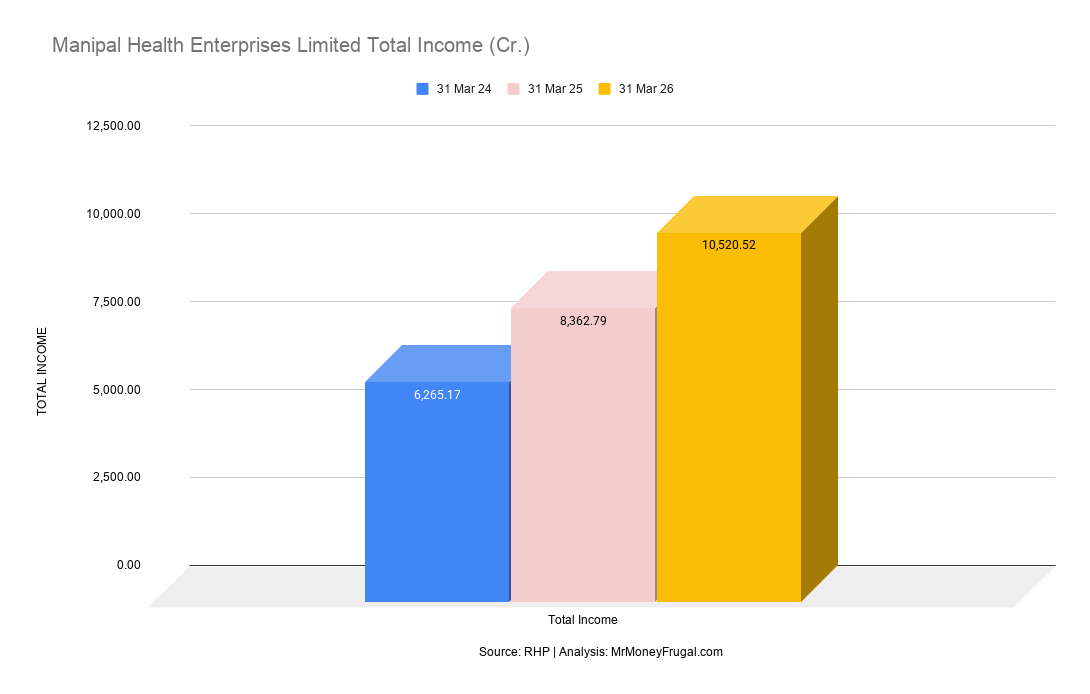
Total Income Grew Nearly 68% from FY24 to FY26
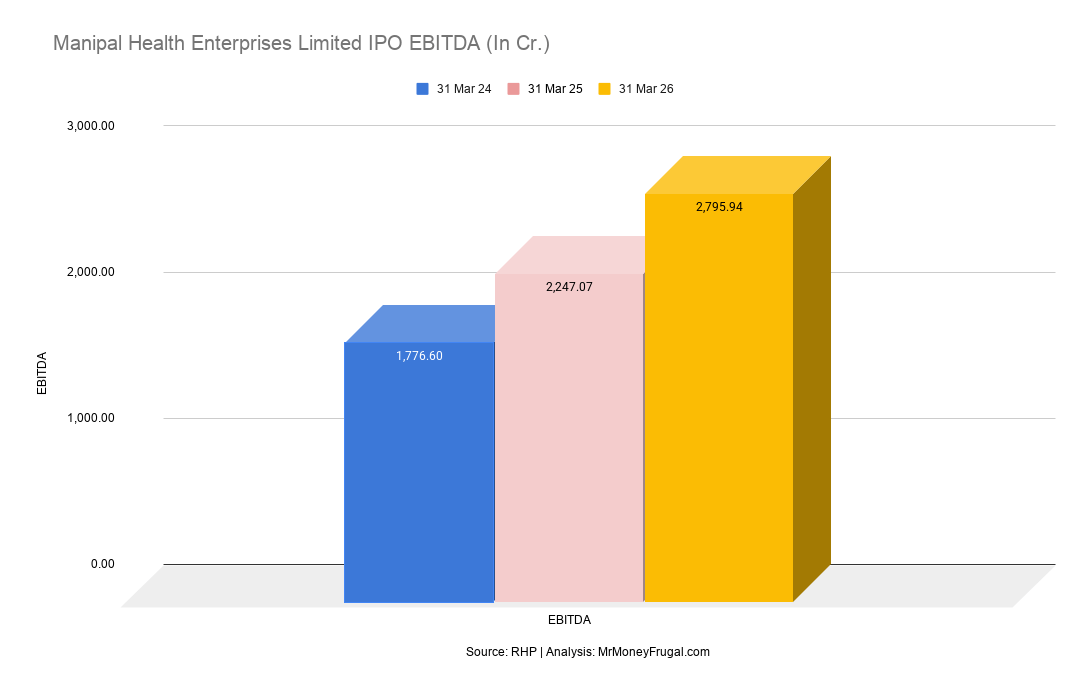
EBITDA Increased Around 57% Despite Rapid Expansion
However, profitability did not follow the same trajectory. PAT increased from ₹533.20 crore in FY24 to ₹1,081.67 crore in FY25, before declining to ₹916.52 crore in FY26, partly due to higher deferred tax expenses and exceptional integration charges.
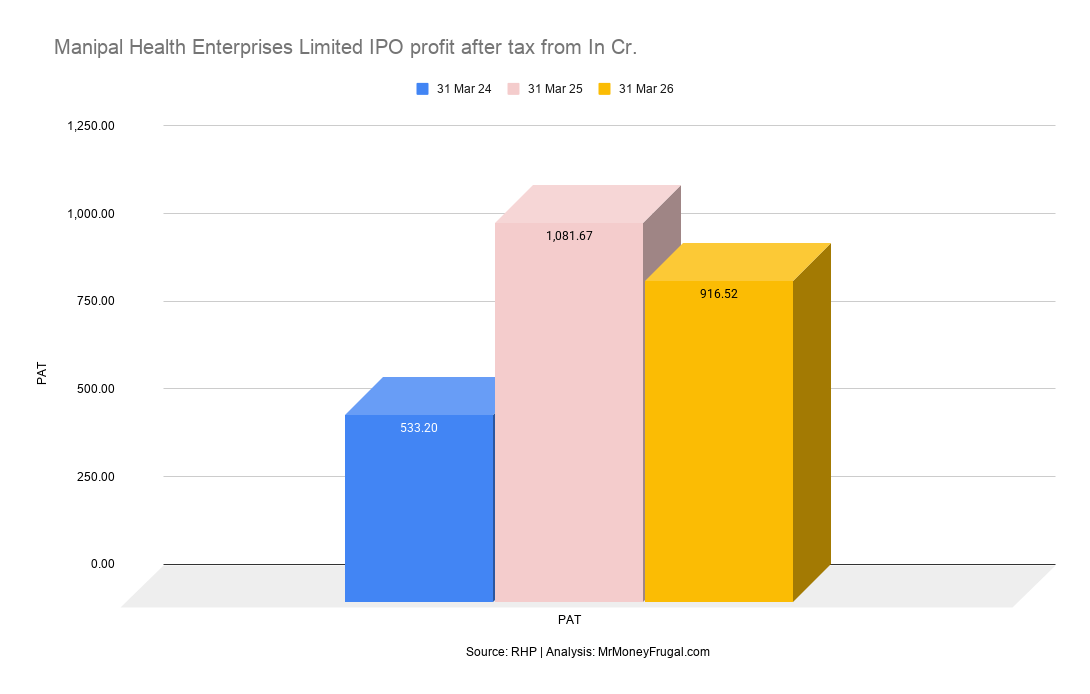
PAT More Than Doubled in FY25 Before Moderating in FY26
The expansion also came with substantially higher leverage. Total borrowings increased from ₹3,943.98 crore in FY24 to ₹10,553.43 crore in FY26, highlighting the debt-intensive nature of the company's acquisition-led growth.
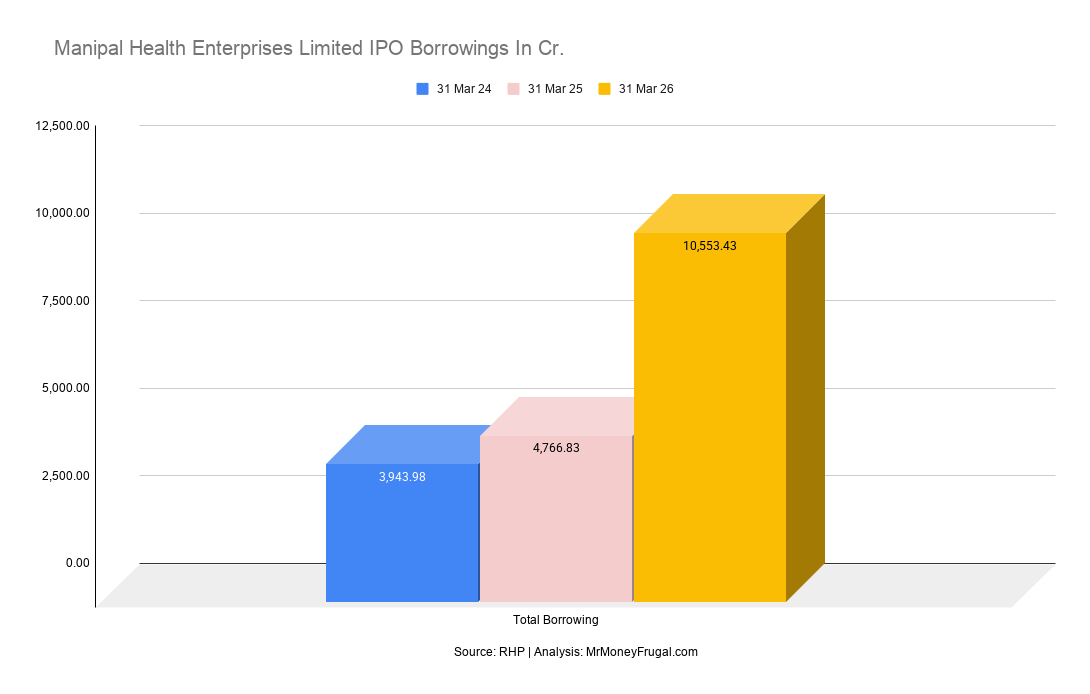
Borrowings Rose Sharply Alongside Acquisition-Led Expansion
Overall, Manipal entered the market with rapid revenue expansion and strong operating earnings, but also declining FY26 PAT and significantly higher debt—a mixed financial picture investors had to weigh before listing.
Premium Valuation Limited the Margin of Comfort
Manipal Health entered the market at an implied P/E of 76.52x at the upper price band of ₹590, making its valuation demanding relative to the listed hospital peers considered in the IPO review.
The company's P/E was higher than Apollo Hospitals at 66.15x, Fortis Healthcare at 70.22x, and Max Healthcare at 74.55x. Manipal's RoNW stood at 10.57%.
However, Manipal also entered the market with considerable scale. Its FY26 revenue from operations of ₹10,335.75 crore was slightly above Max Healthcare and Fortis Healthcare, although substantially below Apollo Hospitals.
Therefore, unlike some attractively priced IPOs, relative valuation itself does not appear to explain the positive listing. Investors were being asked to pay a premium multiple for Manipal's scale, market position and growth potential despite the company's elevated debt and other risks.
Debt Repayment Was the Key IPO Objective
Manipal Health's IPO included a substantial ₹8,000 crore Fresh Issue, alongside an OFS of 2,16,13,834 shares. Unlike a pure expansion issue, a major portion of the fresh capital was intended to strengthen the balance sheet.
The company earmarked ₹5,552.75 crore for repayment or prepayment of NCDs associated with the Sahyadri acquisition, while another ₹574 crore was allocated towards acquiring a minority stake in Sahyadri Hospitals.
This was significant because borrowings had risen from ₹3,943.98 crore in FY24 to ₹10,553.43 crore in FY26. Using a large portion of the IPO proceeds for deleveraging could therefore reduce finance costs and improve the post-IPO balance-sheet profile.
However, the presence of a sizeable OFS meant that not all IPO proceeds were going into the company, with OFS proceeds accruing to the selling shareholders.
If you're unfamiliar with terms such as Fresh Issue, OFS, GMP, QIB, NII or RII, our IPO Glossary explains 100+ commonly used IPO terms.
Market Leadership Supported the Case, but Risks Remained
Manipal Health entered the market as India's largest private hospital network by bed capacity, with 13,037 licensed beds across 49 hospitals. Its high-acuity CONGO-R specialties contributed over 64% of gross inpatient revenue in FY26, while acquisitions added 5,548 beds between FY21 and FY26.
However, the scale came with meaningful risks. Around 46.40% of FY26 revenue came from Karnataka, while aggressive acquisitions created high leverage and ₹8,120.56 crore of goodwill, exposing the company to integration and potential impairment risks.
Therefore, Manipal offered investors a combination of market leadership, scale and acquisition-led growth, but with high debt, geographic concentration and integration risks—helping explain why the investment case remained strong in some areas despite cautious overall subscription.
Why Did Manipal Health IPO List at a 10.51% Premium Despite Weak Subscription?
| Factor | Key Observation | Likely Impact |
| Financial Growth | Total Income +68%, EBITDA +57% from FY24–FY26 | Positive |
| Profitability | FY26 PAT declined to ₹916.52 crore from ₹1,081.67 crore | Mixed |
| Valuation | P/E 76.52x, above listed peers | Negative |
| Investor Demand | 2.65x overall; QIB relatively stronger at 4.19x | Mixed |
| Market Sentiment | GMP fell from ₹55 to -₹15, then recovered to ₹7 | Negative/Mixed |
| IPO Objective | ₹5,552.75 crore earmarked for debt repayment | Positive |
| Business Position | Largest private hospital network by bed capacity | Positive |
| Key Risks | High debt, geographic concentration and acquisition integration | Negative |
Manipal Health's 10.51% listing gain appears notable because neither subscription nor valuation provided an obvious explanation.
Overall demand was only 2.65x, Retail and NII portions remained undersubscribed, and the IPO was priced at a demanding 76.52x P/E.
However, the company entered the market with substantial scale, 68% Total Income growth and 57% EBITDA growth from FY24 to FY26, while QIB demand at 4.19x was stronger than other investor categories.
The proposed use of ₹5,552.75 crore for debt repayment also offered a potential post-IPO deleveraging story.
The biggest surprise remained market sentiment: final GMP of just ₹7 implied roughly 1.19% upside, yet the stock opened at ₹652, delivering 10.51%. In this case, the listing substantially outperformed what both weak broader subscription and late-stage grey market sentiment appeared to suggest.
Key Takeaways
- Issue Price: ₹590
- Listing Price: ₹652
- Listing Gain: 10.51%
- Final GMP: ₹7, implying only around 1.19% premium
- Overall Subscription: 2.65x
- QIB Subscription: 4.19x, stronger than NII and Retail demand
- Positive Factors: Large hospital network, strong Total Income and EBITDA growth, and potential deleveraging through IPO proceeds
- Why It Beat GMP: The ₹652 opening substantially exceeded the modest premium indicated by the final ₹7 GMP despite weak broader subscription.
- Key Risks: Premium valuation, high debt, geographic concentration and acquisition-integration risks.
Related IPO Resources
- Manipal Health Enterprises IPO Review
- IPO GMP Today
- Day-wise IPO Subscription Status
- IPO Allotment Status
- Latest IPOs
- IPO Glossary
- IPO Market Analytics & Research
- Why Did Poojaa Precision Engineering IPO List at a 56.15% Premium?
- Indo-MIM IPO Listed at 44.33% Premium: Here's Why
Explore more IPO Listing Analysis articles on our IPO Market Analytics & Research page.
Disclaimer
This analysis is for informational and discussion purposes only and should not be considered investment advice or a recommendation to buy, sell or hold any security. IPO and listing performance can be affected by multiple market factors, and the relationships discussed above do not establish causation. Investors should conduct their own research and consult a SEBI-registered investment adviser where appropriate.
