
Updated on 04.01.2026 @ 11:21 pm
Nobody wants to live with debt—it’s another name for stress. Yet, due to poor financial decisions, many of us end up trapped in it. This is a clean and updated guide to help you get out of debt in India in 2026, using practical and realistic steps.
Debt is a freedom trap. Getting rid of it as early as possible is one of the most important steps toward living a peaceful and meaningful life. Yet, many people either remain stuck in debt or fall deeper into it. When left unattended, debt can slowly turn life into chaos.
In this article, I have shared practical ways on how to get rid of debt in India, backed by my personal experiences. This guide is designed to help you understand how to control your finances, improve your financial habits, and increase your income over time.
If followed with discipline and consistency, these steps can help you get out of debt and move toward a more stable and confident financial life.
You can also download this complete guide and use it as a personal reference whenever you need direction.
1. Understand Exactly What Makes Up Your Debt
Before thinking about budgets or repayments, take a clear top-view of your debt. Most people avoid this step because it feels uncomfortable—but this is where real progress starts.
List down every debt you currently have, and for each one, note:
The due date
The total outstanding amount
The interest rate
Any late payment charges
Once this is written down, patterns start to appear. You’ll quickly see which debts are silently draining your money every month. High-interest debts—especially credit cards—should always be treated as the first priority.
Create a simple list that includes:
Credit card dues
Personal loans
EMIs
Education loans
Arrange them from highest interest rate to lowest. This gives you clarity on what to attack first, instead of paying everything randomly.
I learned this the hard way. At one point, my credit card due date was around the 24th of the month. By then, most of my salary was already spent, and I had little left to clear the bill. I ended up rolling the dues to the next month and paying penalties—money that added no value to my life.
Later, I made a conscious change. I planned my car loan EMI between the 1st and 5th of the month, so it could be paid immediately after my salary came in. That single adjustment removed stress and unnecessary charges.
Many people stay in debt not because they borrow too much, but because they don’t structure their repayments properly. Understanding your debt and aligning due dates with your cash flow can save you far more money than you realise over time.
2. Seek Financial Guidance
You must have a clear understanding of your debts. This includes knowing the terms and conditions, interest rates, and early repayment benefits associated with each loan or credit card.
Start by noting how many financial institutions you have borrowed from and the specific terms of each facility. If you have multiple credit cards, loans, or EMIs from different institutions, understand that not all of them operate under the same conditions. Some may offer lower interest rates or better benefits, while others may be more expensive over the long term.
Comparing these details can help you identify opportunities to reduce costs, simplify repayments, or shift your focus toward clearing high-cost debt first. This process not only helps in saving money but also makes debt management more structured and manageable.
From personal experience, I once had three credit cards, and not all of them were equal in value. After comparing their features and costs, I realised that only one card offered meaningful benefits. Over time, I paid off the other two and retained the one that made the most financial sense.
3. Check Your Credit Report and CIBIL Score
No matter whether you are carrying debt or not, credit bureaus always record your spending habits. If you default on your dues, they lower your financial credibility by reducing your credit score. If you pay on time, they reward you equally.
A higher credit score indicates better financial discipline and makes you a stronger borrower, which can help you get better deals on credit cards and loans.
Checking your credit score is as important as maintaining good financial habits. Your credit report helps you understand what debts you have, where you may have defaulted, and how frequently such defaults have occurred.
Carefully monitoring your credit report can help you manage your debts more responsibly. The good news is that in India there are four credit bureaus, and you can get your credit report free of cost from each of them once a year.
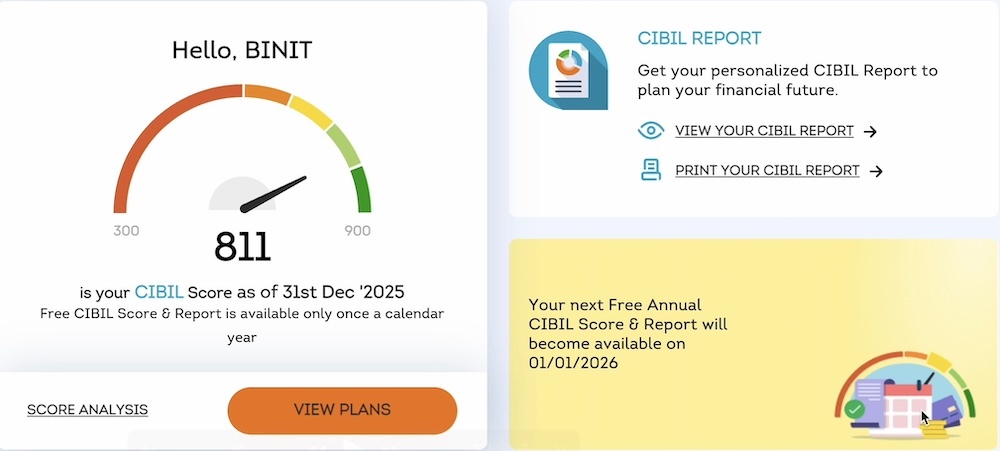
I recently checked my CIBIL credit score, and it was 811, which reflects strong financial discipline. This is because I keep a close watch on my spending, pay my dues on time, and do not get attracted to new credit or loan offers unnecessarily. As a result, I am currently debt-free. You can achieve the same milestone with discipline and consistency.
4. Know Your Income and Expenses
The major debt problem arises when we don’t figure out what we earn and what we spend.
Technically, you will be in debt if you spend more than you earn. So, the first thing you need to do is work on this.
Make a list of the things you spend money on every month. Write down how much each thing costs, and then add them all together. After that, calculate your monthly income.
If you are already in debt, your income will usually be less than your expenses. You need to fix this. Otherwise, whatever you do, you will not be able to get out of debt.
I have experienced this myself. When I got my first job, I was excited and spent freely. In fact, by the last week of the month, I hardly had anything left. This continued until I started balancing my income and expenses.
So, start working on this today. A simple Google Sheet or Excel spreadsheet can record everything and help you out. You can also note down your expenses in a small notebook. It is that simple. And if you want to get out of debt, you need to start today.
You can also use Apps and track it from your smartphone.
5. Create a Monthly Budget
Now that you know your income and expenses, it is time to create a budget. A budget will help you pay off debt faster.
You can also use free online budgeting tools that make budget planning easier.
A budget basically tells you where your money should go, not where it is currently going. Once you have a budget in place, half of your goal is already achieved because it clearly lists the essential things you need to spend money on.
Every government has a budget that decides where its money will go. In the same way, keeping a personal budget can help you take control of your finances and move closer to getting out of debt in India.
I, too, maintain a budget. In fact, I recorded all my expenses in a Google Sheet for an entire year to understand where my money was going every month. This habit played an important role in helping me achieve financial freedom at the age of 42.
6. Control Daily Spending and Avoid New Debt
Now you have a budget. You know where your money should be spent. And because you are also recording all your expenses, you clearly know where your money was going.
If you find that your money is getting spent on things that do not add value to your life, you need to cut them out.
A few years ago, I realised that I was spending close to ₹6,500 every month on cigarettes alone. Was this good? No.
I immediately started working on controlling this habit. Reducing it helped me achieve two important things. First, smoking is injurious to health, and cutting down improves my well-being. Second, it saved money.
The money saved can now be used for better purposes—investing in SIPs, building new skills, paying off existing debt, or even helping someone in need.
7. Reduce Daily Expenses Wherever Possible
Money is hard-earned. And you know it.
So, it should be used for things that truly matter. But often, we end up spending more money on the same things that we could have purchased at a lower cost.
For example, there are many coupon and deal platforms where you can find discount offers that help you save money. I once booked a hotel for just one rupee by using an app offer. The same hotel would have otherwise cost me more than ₹2,500 per night.
On another occasion, I booked a flight at a discount of over 15% directly from the airline’s website. Along with the lower fare, I also received a complimentary meal and preferred seat selection at no extra cost.
Small efforts like these can significantly reduce your expenses on important purchases. In just a few minutes of browsing, I saved ₹2,500 on a hotel booking. Over time, such savings add up and can make a real difference in managing debt.
8. Know Your Debt Ratio
Now that you know what you can afford to spend and what you cannot, it is time to understand the ratio of your debt to your income.
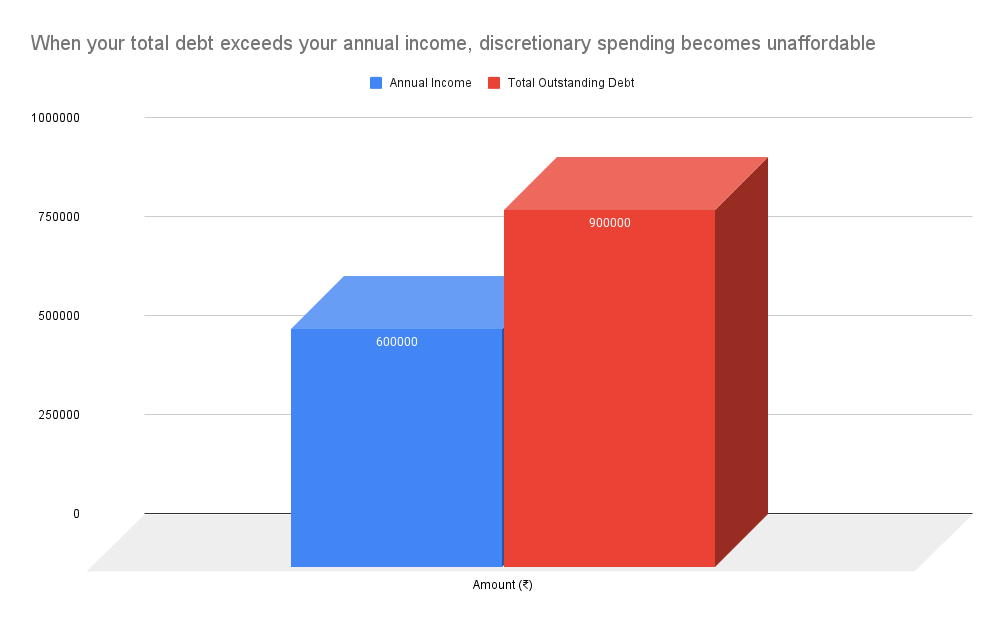
Add up all your outstanding debt and divide it by your annual income. This gives you a clear picture of how heavy your debt burden is.
If this ratio is greater than one, it means your debt is higher than your yearly income. In such a situation, indulging in discretionary spending is not affordable. The reality is that you cannot afford unnecessary expenses or lifestyle purchases until this ratio improves.
Pay close attention to this metric and review it every three months. This will help you track your progress as you repay debt. Ideally, this ratio should steadily decrease over time.
I have seen people buying expensive smartphones on EMIs, not based on their own income but relying on family support, such as their parents’ earnings. This reflects poor financial judgment and weak financial independence.
I also know someone who owns an iPhone 14 while earning less than ₹15,000 per month. Decisions like these often lead to long-term financial stress and deeper debt.
9. Negotiate Interest Rates and Monthly Bills
Now that you know your budget and have improved your credit score, it is time to start negotiating your expenses.
The idea is that many of your existing expenses are negotiable. This includes utility bills, telephone plans, credit card interest rates, and even fixed charges such as processing fees on new loans. When you understand your financial position and have a good credit score, you are already in a stronger position than borrowers with poor credit. This gives you an added advantage while negotiating interest rates and charges.
Even a small reduction, such as 0.5% in interest rates, can make a meaningful difference over the long term. When you have the option to pay less, there is no reason to pay more.
The money saved through negotiation can always be used to improve your financial position further—whether by investing, building new skills, or creating additional income streams, such as blogging and sharing your own experiences.
10. Consider Debt Consolidation
Debt consolidation means that instead of owing money to too many lenders, you try to limit your debt to a few better ones.
There are many financial institutions in India, and all of them need business. To grow their business, they need reliable, paying customers. So, just as you need them for loans and credit, they also need you as a borrower.
Because of this, you often get opportunities to renegotiate terms and aim for better outcomes that can improve your financial life. Debt consolidation is one such approach.
For example, if you have a personal loan at an interest rate of 12%, and over time you improve your credit score, you can look for lenders offering lower rates and shift your loan accordingly. Finding a lender who offers better terms can help reduce interest burden, improve cash flow, and strengthen your credit profile.
I have personally done this. I once had two loans—one from Vijaya Bank (which I believe has since been merged) and another from State Bank of Mysore. I cleared the Vijaya Bank loan by transferring and managing the debt through State Bank of Mysore, which helped me simplify my repayments.
11. Use Balance Transfers to Reduce Interest Costs
Balance transfer strategies can be useful only when used with discipline.
I personally have two credit cards—one from AU Bank and another from HDFC Bank. Both cards have a credit limit of ₹3.5 lakh each. This gives me flexibility in case of emergencies, without needing to approach a bank immediately.
The due dates on these cards are different. The AU Bank card has a due date around the 13th of the month, while the HDFC Bank card’s due date falls around the 7th or 8th. This gap provides a short window to manage cash flow more efficiently.
At times, I use this gap to settle one card’s dues and then repay the other within the interest-free period. This works only because I track expenses closely and ensure full repayment within the billing cycle.
This approach should not be used as a way to fund lifestyle expenses or delay payments habitually. If not managed carefully, balance transfers and credit card rotations can quickly lead to higher debt and interest charges.
12. Don’t Do EMIs on Your Credit Card Dues
Your credit card bill shows two amounts—the total due and the minimum due. When it comes time to pay, this choice matters a lot.
The total due amount is the actual amount you are required to pay, not the minimum due. However, many people choose to pay only the minimum. The remaining balance does not stay interest-free—it attracts very high interest charges.
If you are unable to pay the total due amount, it clearly indicates that you are spending more than you should. In such cases, you need to immediately work on reducing your expenses, as discussed in the earlier sections.
Do not fall into the trap of paying only the minimum due. Also, be careful with so-called interest-free EMIs on credit cards. These often encourage higher spending and can slowly push you into long-term debt.
I personally always pay my credit card bills in full because I keep my spending under control.
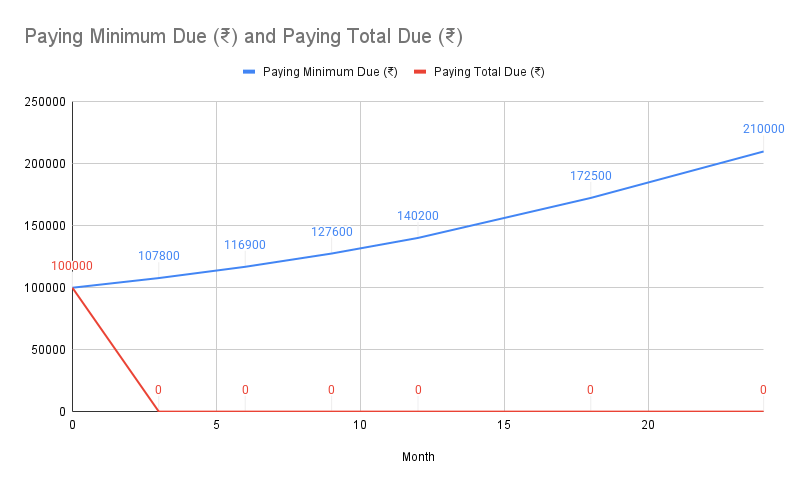
(Figures are illustrative. Actual credit card interest and outstanding may vary based on bank policy, daily compounding, GST, and payment behaviour.)
13. Try to Sell Things
Due to the influence of instant gratification, we often buy things we don’t really need and later realise it. However, instead of correcting the mistake, we either take no action or become emotionally attached to those items.
In both cases, it harms our finances. A better approach is to get rid of things that no longer add value to your life. Selling unused items can provide immediate liquidity and, over time, a sense of peace of mind.
At one point, I owned two cars, but I was hardly using even one. The second car was not bought out of impulse, but when my first car crossed 12 years, I decided to buy a new one. In reality, I didn’t need it.
Along with the purchase came recurring costs like insurance and regular maintenance, which added up to a significant amount. I eventually decided to sell the second car.
This not only gave me liquidity but also helped me save on unnecessary maintenance and ongoing expenses.
14. Increase Your Monthly Revenue
Once you have improved your credit score, created a budget, started monitoring where your money goes, and cut down your expenses, it’s time to let your money work for you.
When you start doing all these things, you begin to experience that you have money which should be invested and allowed to grow.
At this stage, you also start feeling that there are various ways to increase your income.
The good thing is that by now, you already have real-life experience with money to share.
You can write on your own website, sharing how you improved your life through better financial decisions.
This is one of the smartest ways to improve both your life and the lives of others. People want to learn from real experiences.
If you don’t know what to write or where to start, you can learn blogging or copywriting and start applying for new gigs to boost your income.
Once you get rid of money troubles, you start seeing opportunities all around you. You only need to participate in the ones that make sense for you.
And once you increase your monthly income, you get more options to grow your money. You can learn about upcoming IPOs or explore mutual funds as investment options.
Even a small sum, if invested for the long term, can generate meaningful results. You can understand this better using a SIP calculator and a retirement calculator to see how consistent investing compounds over time.
I started investing with just ₹500 in 2010, and over time, it helped me build the financial freedom to work on my own terms.
Conclusion
Getting out of debt is as simple as becoming aware of how you got into it. It starts with being mindful of your income and expenses.
Reduce what you can from your expenses and work consistently on increasing your revenue. Maintaining a budget, monitoring spending, getting rid of unused things, and creating multiple ways to earn can put you in a far more comfortable financial position.
All the sections above share practical steps backed by real-life experiences. They show that getting out of debt and building a better financial life is possible.
The only thing left is action. Take the first step and start now.
FAQ: How To Get Rid Of Debt In India
1. Should I repay debt or invest first in India?
I think you should do both. You can’t wait to invest, and you also can’t wait to repay your debt. You need to plan and come up with a good approach. Use the insights shared above, and you will find better options.
2. Should I stop SIPs to clear debt?
SIP is a way to invest for your future. You should ideally do SIPs only with money you don’t need in the near future or money meant for long-term goals of 8–10 years or more. Because of this, stopping SIPs is generally not recommended.
However, if you find yourself under heavy debt with no clear way to manage repayments, you can pause or adjust your SIPs and plan accordingly. That said, completely stopping investing can be financially risky in the long run, just as getting into excessive debt can be.
3. How long does it take to become debt-free?
It depends on how much debt you have. Have you calculated your debt-to-income ratio and understood what the numbers look like? The options discussed above can help you find a realistic path to becoming debt-free as early as possible, provided you work on them consistently.
4. Which debt should be paid first?
The debt that is costing you the most. It is that simple. Debt with a higher interest rate should be cleared first.
5. How much emergency fund is enough?
You can plan for 6–9 months of your monthly expenses. So, if your monthly expenses are ₹50,000 (including both monthly and yearly expenses), you should aim to keep ₹3–4 lakh parked in liquid funds or bank accounts that can be withdrawn easily without waiting.
6. Can mutual funds help after debt clearance?
Mutual funds are a way to invest in equity markets. As per historical data, equity investments have outperformed many other investment options over the long term.
So, they may help if you choose good funds and plan with a long-term approach.
However, mutual fund investments are subject to market risks, and you should get your investments assessed by an IFA before investing.
