
During the 2026 market crash triggered by ongoing global conflict, I lost ₹18.63 lakhs in portfolio value in less than 30 days.
Everybody’s mutual fund and stock portfolio isn’t just down—it has fallen sharply. There is chaos everywhere.
People are checking their portfolios multiple times a day—some almost every hour. The screen is filled with red, and it feels like there is no hope left in the market.
New investors—who started in 2026 as part of their New Year resolutions—are already questioning their decisions. Those who started a few years ago are seeing their portfolios come back to their invested amount… or even below it.
And long-term investors?
They are holding on, hoping this phase will pass—just like previous crashes.
Countries far away are at war. But its impact is not limited to borders—it is spreading across markets, inflation, headlines, and investor psychology.
And yes… My portfolio is also falling day by day.
In this article, I will share:
- My actual portfolio numbers before the war started vs 28 March 2026
- How much my investments have fallen (real returns)
- The mistakes I made during this phase
- And the key lessons I’ve learned from 16 years of investing, including the COVID-19 market crash on which I have already shared a detailed post.
Let’s get started.
My Mutual Fund Portfolio Value Before the Crash
Here is a brief snapshot of my portfolio before the 2026 market crash (as of 27 February 2026):
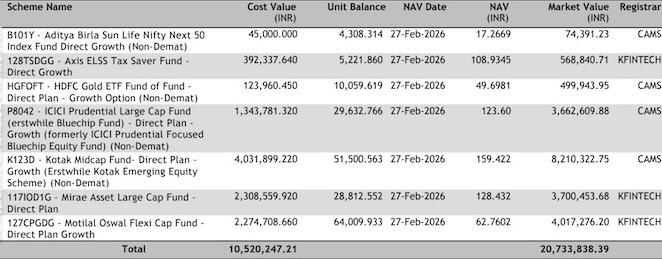
My actual account statement of mutual fund holdings on 27.02.2026
Sensex: 81,287.19 (the market had already fallen from its peak of 86,159.02) Total mutual fund portfolio value: ₹2,07,33,838.39
(Note: I am not including my stock portfolio here.)
It took me years to build this portfolio. You can also see how I built a ₹1 crore portfolio starting from just ₹500.
What Happened During The Crash
The market fell sharply. The Sensex closed at 73,583.22, down 9.5% from 81,287.19 on 27 February. Here is a snapshot of my portfolio:
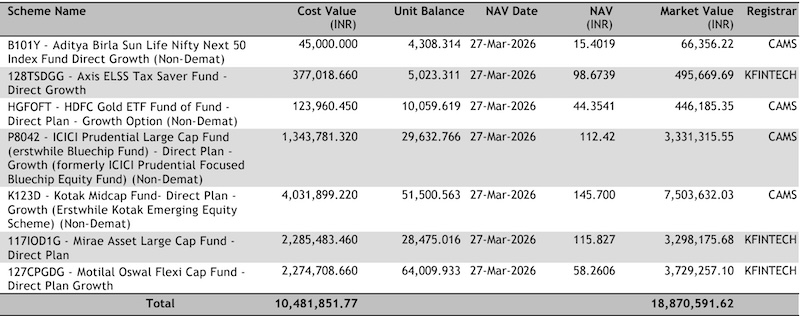
My actual account statement of mutual fund holdings on 27.03.2026
Total mutual fund portfolio value: ₹1,88,70,591.62 (as of 27 March 2026) Portfolio decline: 8.9%
The market reacted sharply due to uncertainty caused by the ongoing conflict.
India and its companies rely heavily on petroleum imports from regions affected by the conflict. Fuel is a critical driver of the economy—any disruption in supply can impact productivity across multiple sectors.
All these factors have put significant pressure on the Indian markets.
And one more thing, the market is still falling. And I don’t know how much my portfolio will fall in the near term.
My Decisions During This Period
While I don’t like seeing my portfolio go down like this, I know that if I sell now, I will be locking in my losses.
If I stay invested, there is a strong possibility that the market will recover and my portfolio will regain its value over time.
However, panic is not uncommon in such situations. There is always a fear of losing everything.
This is why only the money that you can afford to keep invested for the long term should be put into the market.
Since my goals are long term, I am continuing to stay invested.
This is something I have observed across multiple crashes in my 16 years of mutual fund investing.
If you’re new to mutual funds, you can check our mutual fund learning platform where we have answered 100+ important questions in a simple and clear way.
Mistakes I Made
While I have been investing for a long time—16 years—I still made a key mistake during this crash.
I was not able to take advantage of the opportunities that came with the market fall.
I can see many fundamentally strong stocks that are down significantly. Investing in them for the long term could have boosted my portfolio. But I couldn’t act.
The reason is simple—I did not maintain a cash buffer.
I now realize that having a cash allocation is equally important in investing. Keeping even 5–10% in cash can help during emergencies and also allow you to take advantage of such opportunities.
This is a big learning for me.
Going forward, I will maintain a dedicated cash allocation of at least 5–10% of my portfolio, so that I don’t miss such opportunities again.
You can explore similar insights and learnings in our Real Investing Stories section.
What Worked Well and What Will Continue
Even though the market is down and my portfolio value has declined significantly, one thing I believe I have done well is not panic selling.
I also hold good mutual funds, some of which I have owned for a long time—some even for 14 years.
I still hold the same number of mutual fund units as before the crash. Only the NAVs have gone down.
If the NAVs recover, my portfolio value will recover as well.
This is a well-built portfolio created through years of disciplined investing. It has seen multiple downturns and has always recovered over time.
In contrast, I exited my ULIP within 3 years, as it did not suit my portfolio. I have shared that experience in detail in my ULIP mistake article.
Key Lessons for Investors
I know this is a tough time—especially for investors who have just started.But having seen multiple market crashes, here are the key lessons I’ve learned:
1. Avoid panic selling: Panic selling is one of the biggest reasons investors incur losses.Once you sell, you lose the chance to participate in any recovery.In my case, I benefited by doing nothing during such phases.
2. Keep cash ready to invest: Market falls often create rare opportunities.Check the current NAVs of your funds and compare them with your purchase levels.If the fundamentals remain strong, consider investing additional money—only what you can afford.
3. Don’t keep checking your portfolio constantly: Watching the screen all the time increases stress and may lead to poor decisions.Limit exposure to constant news and market updates.
4. Read and build conviction: Reading can provide clarity and confidence during uncertain times.Focus on quality books—not noise or “investing hype.”If you’re unsure where to start, you can reach out to me at binit@mrmoneyfrugal.com.
5. When in doubt, do nothing: If you feel anxious and unsure, it’s better to stay inactive than make impulsive decisions.
Conclusion
Market crashes always teach us new lessons.
The COVID-19 market crash was different.
The 2008 financial crisis was different.
And 2026 is different again.
But they all reinforce one important lesson:
Never invest in assets you cannot hold for the long term.
Never invest money you cannot afford to lose.
And most importantly—don’t act in panic.
FAQ: I Lost ₹18.63 Lakhs in 30 Days: My Portfolio During the 2026 Market Crash (Real Story)
1. Should I stop my SIP during a market crash?
From my experience, stopping investments during a crash is not a good decision. These phases are temporary, and if you continue investing, you get more units at lower NAVs. When the market recovers, it helps your portfolio grow faster. The key is to stay invested and avoid panic decisions.
2. What should I do when my portfolio is falling continuously?
I have seen that doing nothing is often the best decision in such situations. Selling in panic locks in your losses and removes any chance of recovery. If your investments are in good funds and your goals are long term, staying invested is the right approach.
