
Beating the Street by Peter Lynch is the book I bought in 2014.
I have read it multiple times.
Why?
Because it is one of those rare books that gives you new insights every time you read it.
Each revisit offers practical wisdom that can help make you a better investor.
The book is old and was originally published in 1993, more than three decades ago. Yet the investing wisdom inside remains evergreen.
It is a treasure of practical knowledge and lessons drawn from real market experience.
In this article, I will share the five most important lessons I learned from the book that changed the way I invest today—whether in mutual funds, IPOs, or stocks.
If you are interested in learning the basics of mutual funds, you may find our mutual fund learning platform useful.
You can also explore our latest IPO section for regularly updated IPO news and details.
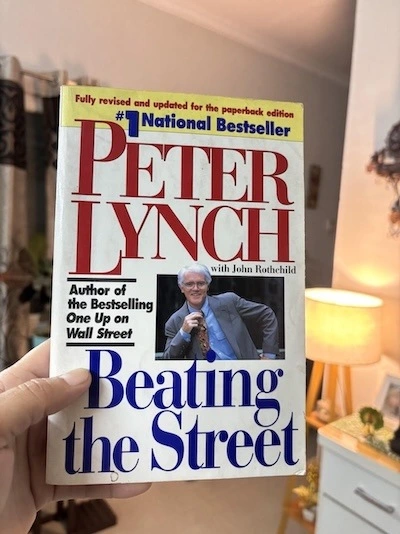
So, Who Is Peter Lynch?
Peter Lynch does not need much introduction in the investing world.
People interested in investing already know him well and continue to use many of his insights even today.
But for those who are new to investing, Peter Lynch was the fund manager of the Fidelity Magellan Fund. When he joined the fund, its assets under management were only around $18 million, which later grew to nearly $14 billion in less than 13 years.
Not only this, he also delivered an outstanding CAGR of around 28% during that period, far higher than overall market returns and many other funds.
So, Peter Lynch is like a living library of investing knowledge.
His acumen, practical experience, and ability to grow one of the biggest funds of its time while generating exceptional returns make him one of the most successful stock pickers of modern times.
Now move to the lesson 1 of the book:
Lesson 1: Research Builds Confidence
If you do not research a stock before investing, you do not truly know what you own. It is like travelling without knowing the road or the destination.
That can be dangerous in investing.
Without research, every fall in the stock price can create fear and panic.
You may not know whether the company is fundamentally strong and simply reacting to market sentiment, or whether the business is weak and declining because of poor financial health.
That is why you should not invest until you have done proper research on the company.
When a stock falls, many investors panic and sell. At the same time, some investors buy more of the same stock because they understand the business, believe it remains strong, and use the opportunity to average down their buying cost.
I personally experienced this during the COVID-19 market crash, when stock markets fell sharply by more than 30%.
I remained relatively calm because I knew the quality of my mutual fund portfolio and understood that the fall was driven largely by overall market sentiment and uncertainty.
As the market later recovered, those who stayed patient were rewarded with strong returns.
So research first, and invest only when you understand the business and believe it is suitable for your investment goals.
Lesson 2: Diversification Reduces Damage
Diversification is important. It helps reduce the chances of poor performance in your overall portfolio and protects you from the damage caused by a single bad investment.
Peter Lynch says that if you invest in five stocks, one may surprise you with strong performance, three may perform reasonably well, and one may perform poorly. That is why building a portfolio of good stocks after proper research can be a smart approach.
But do not over-diversify.
Diversification is meant to reduce risk, not to stress yourself with too many stocks or mutual fund schemes that you cannot properly track and monitor.
So diversify wisely—enough to reduce losses, but not so much that managing your portfolio becomes difficult.
Lesson 3: Invest In Small/MidCap Funds or Stocks.
Large-cap funds or stocks are generally more stable and can provide consistency.
However, a significant part of long-term growth often comes from small-cap and mid-cap companies, as they may have more room to expand compared with already mature large businesses.
That is why a portfolio with some exposure to small-cap or mid-cap stocks and mutual funds can act as a growth driver over the long run.
You can also observe that many of today’s large-cap companies were once small-cap or mid-cap businesses in their earlier stages.
I have seen this in my own mutual fund portfolio as well.
Over certain periods, schemes focused on mid-cap and small-cap segments have delivered better returns than some large-cap-oriented schemes, although they also come with higher volatility and risk.
Lesson 4: Cheap Stocks or Penny Stocks Can Be Expensive Mistakes
I once bought a stock at ₹0.60, and it later fell to ₹0.13. After that, the company was delisted, and I lost my entire investment.
That experience taught me an important lesson.
If something looks cheap, it does not mean it is cheap in value or that you are getting it at a bargain price. It may actually be a value trap.
That is why Lesson 1—research before investing—becomes so important.
So, never chase a stock only because it is a penny stock or trading at a very low price.
A stock priced at ₹2,000 can sometimes be far more valuable than a stock priced at ₹1, because one business may have growth potential while the other may be declining with weak revenue or poor prospects.
So do not chase penny stocks blindly. They can turn your portfolio into pennies.
Lesson 5: Treat the Market Like a Business
A business requires time, effort, patience, and continuous learning to succeed.
The stock market should be treated in the same way.
You need to learn, gain experience, learn from mistakes, and keep reading so that you become stronger and more efficient in making investment decisions.
But many people take the market lightly.
They often expect to double their money in a year or two without doing any meaningful work. That mindset can be harmful.
If you treat the market like gambling, you may lose like a gambler.
Treat it like a business. Give it your time, effort, and discipline—only then can it work in your favor over the long run.
Conclusion:
Beating the Street is one of the best investing books available even today because it does not speak from theory alone, but from real experience.
The author has written what he actually did in the market, and that makes it a far more powerful learning resource.
While the book contains many more lessons that can help make you a better investor, I found these five lessons especially useful.
I also believe that if I had applied them earlier, I could have avoided some of my losses.
So, what do you think?
What did you learn from these lessons, and do you have any investing lesson you would like to share with us?
