
Retirement age may be 58 on paper.
But in reality, you can be out of your job anytime — maybe at 40, 42, or even 38.
So if you’re living with the idea that retirement only starts at 58, you may actually be compromising your financial security. You’re taking your personal finances for granted.
Just imagine this for a moment: You’re 42 years old, and one evening you receive an email or phone call saying that you’ve been laid off.
And layoffs are no longer rare today. Companies are not laying off 1, 2, or 3 employees at a time — sometimes they lay off tens of thousands.
The reality is simple: there is no guaranteed retirement exit in the corporate world. You have to plan your own retirement.
And you should not plan it tomorrow or someday later. You should start now.
The good news is that today we have access to powerful investment options that can help us build wealth and work toward financial freedom from the very beginning of our careers — without needing huge amounts of money.
You can start investing in good mutual funds through SIPs with as little as ₹500, and in some cases even ₹100.
So in this guide, we’re going to talk practically — no fluff — about how to build long-term wealth, plan early retirement, and start creating financial freedom from the day you receive your first salary. Because inflation will rise, jobs will be gone but we have to eat, sleep, drink and enjoy.
So let us start building our financial freedom from today.

What Does Early Retirement Actually Mean?
What comes to your mind when you think about retirement?
If you still imagine old age, pensions, sitting at home, and waiting for life to slow down, then you’re thinking about retirement in the traditional way.
But times have changed.
Today, people know that jobs are no longer guaranteed. Layoffs have become common, industries are changing rapidly, and depending entirely on a monthly salary has become risky.
That is why the meaning of retirement is also changing.
Early retirement does not mean stopping work forever. It means achieving enough financial freedom to live life on your own terms without depending completely on a paycheck.
And that age could be 30, 35, 40, or even later depending on your goals and lifestyle.
It means having the freedom to make decisions without constantly worrying about job loss, monthly bills, your children’s education, or financial stress.
In simple words, early retirement is not about escaping work. It is about escaping financial dependence and gaining more control over your life.
And the reality is that many people are already working toward it through disciplined investing, SIPs, mutual funds, and long-term wealth creation.
Why Most Indians Struggle After Retirement
Look at retired people around you and ask them about their biggest financial challenges. Most of them will often complain about the following things.
Not Starting Retirement Savings Early
Most people do not start saving or investing for retirement early in their careers. They delay savings and investing because they believe they still have a long working life ahead and that retirement is very far away.
Lack of Financial Education
Many people never properly educate themselves about investment products that could have improved their financial condition after retirement.
As a result, they often choose products that do not suit their needs. For example, like I shared in my ULIP mistake, more than 25% of my premiums were being consumed by administrative and related costs. I kept paying premiums until I later learned that I should close the product.
Similarly, many people invest through regular mutual funds instead of direct mutual funds because they never learn the benefits of choosing direct plans.
Keeping Most Savings in Fixed Deposits
Most Indians prefer keeping their savings parked in Fixed Deposits (FDs) or similar debt instruments because they feel safe.
But safe investments can become the wrong products if they fail to beat inflation. What is the use of calling returns safe when the real returns become negative after inflation?
Ignoring the Impact of Inflation
Inflation continuously reduces the value of retirement savings year after year.
During their active earning years, many people forget to calculate how much their future expenses may increase after retirement.
They often underestimate how rising prices continue increasing the cost of products and services over time.
Not Investing in Equity or Mutual Funds
Many people do not invest in mutual funds or other equity-related products that could potentially generate inflation-beating returns.
Very few people in India invest in mutual funds compared to many other countries.
While mutual funds do carry risks, they have historically delivered better long-term returns than many traditional investment products.
As a result, many people fail to build diversified portfolios with growth-oriented investments.
Not Planning for Medical and Lifestyle Expenses
Many people also fail to properly plan for medical expenses, travel, leisure, and other lifestyle costs after retirement.
A large number of people rely on employer-assisted medical plans or government support during their working years but do not create their own healthcare backup.
After retirement, rising medical costs can create a heavy burden on their retirement funds.
These are some of the most genuine retirement challenges faced by many people today.
However, if people plan carefully during their active earning years, they can gradually build wealth and work toward achieving financial freedom earlier in life.
The Biggest Wealth Building Secret — Time & Compounding
All of us know about compounding. But only a few people truly experience its impact in their financial lives. And the reason is simple — we don't give compounding enough time to work for us.
So, instead of just talking about it, let's experience it through a few examples and see how powerful it can be.
Let us assume a person gets her first job at the age of 22 and starts investing from her very first paycheck.
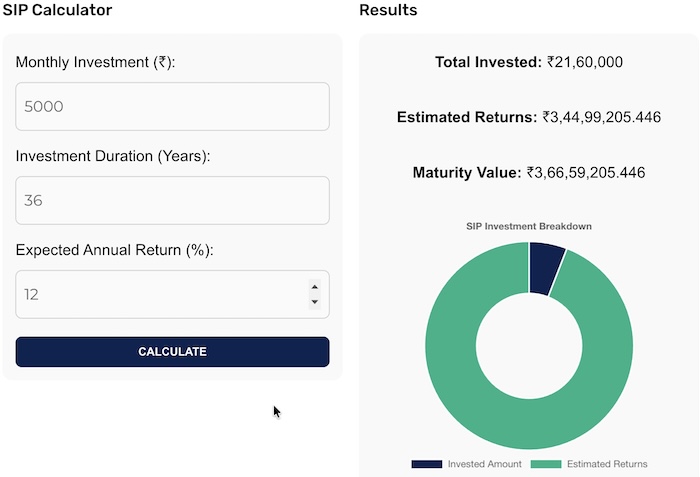
Now, move to our SIP Calculator and see how it works.
She starts with a SIP of only ₹5,000 per month and remains disciplined for the next 36 years. Let us assume she plans to work until the age of 58.
In total, she invests only ₹21.6 lakh over those 36 years.
If her investments generate an average return of 12% per year, she will accumulate approximately ₹3.66 crore by the age of 58 — nearly 17 times her total investment.
Now consider another person who starts investing at the age of 32 instead of 22.
To compensate for the lost time, he invests ₹10,000 per month and plans to retire at the age of 58.
Even after investing a total of ₹31.2 lakh, he accumulates only about ₹2.15 crore — roughly 7 times his invested amount.
Isn't that a huge difference?
The lesson here is simple: time is more important than the amount invested.
If you start early, even a small monthly investment can grow into a substantial retirement corpus. The more time you give compounding, the harder it works for you.
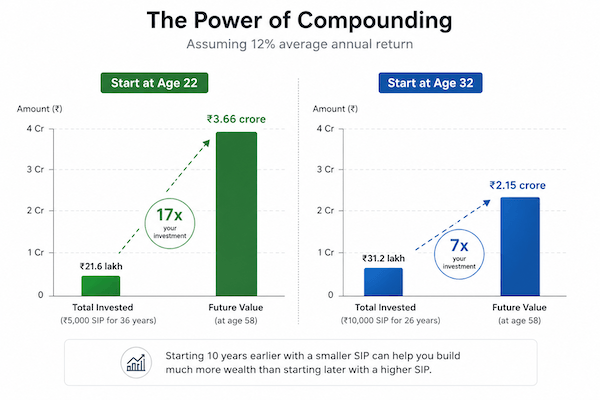
Starting 10 years earlier created a larger retirement corpus even with a smaller monthly SIP. Time, not money, is often the biggest driver of wealth creation.
I have already shared my own investing journey where I started with only a ₹500 SIP in a mutual fund. Over time, whenever I received an increment or bonus, I gradually increased my investment amount.
That simple habit helped me accumulate more than ₹1 crore in investments within just 11 years.
So what do you think?
Will you wait, or will you start building your financial future today?
And if you're interested in learning more about mutual funds, check out our dedicated Mutual Fund Learning Hub for beginners, where we answer more than 100 common mutual fund questions in simple and easy-to-understand language.
How Much Money Do You Need To Retire Early In India?
If you don't know how much you spend every month, you cannot answer this question.
So, figuring out your current expenses is very important.
And for that, you need to include all expenses.
Some expenses occur quarterly, yearly, or once every few years, so they should be converted into monthly expenses to get a realistic figure. For example, car insurance, annual maintenance, vacations, and even replacing your car after a few years should be considered.
Let us assume your current monthly expenditure is ₹80,000.
Now let's assume:
Current Age: 35 years
Retirement Age: 58 years
Time Available: 23 years
Inflation Rate: 6%
The next question is: how much will ₹80,000 be worth 23 years from now?
Using our Retirement Calculator, the answer is approximately ₹3.05 lakh per month.
In other words, a lifestyle that costs ₹80,000 today may require more than ₹3 lakh per month after 23 years because of inflation.
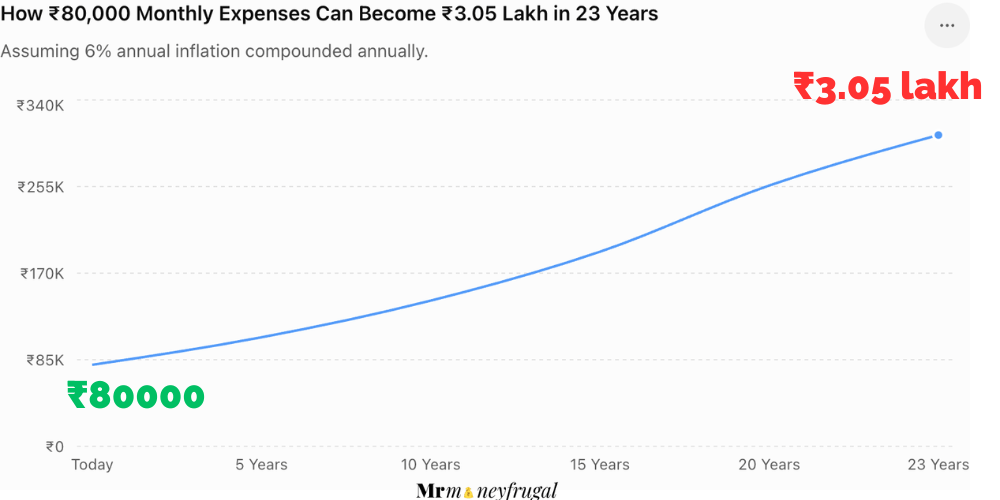
A monthly expense of ₹80,000 today may require approximately ₹3.05 lakh per month after 23 years if inflation averages 6% annually. This is why retirement planning should always consider inflation and not just current expenses.
Have you planned for this?
If not, let us calculate how much retirement corpus may be required to support that lifestyle.
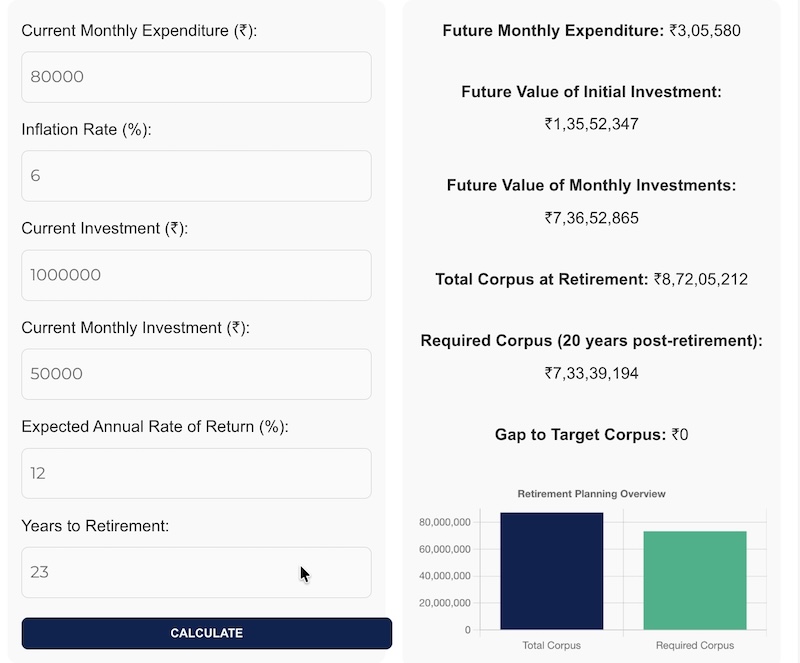
Using the following assumptions:
Current Monthly Expenditure: ₹80,000
Inflation Rate: 6%
Current Investments: ₹10,00,000
Monthly SIP: ₹50,000
Expected Annual Return: 12%
Years to Retirement: 23
The calculator gives the following results:
Future Monthly Expenditure: ₹3,05,580
Total Corpus at Retirement: ₹8,72,05,212
Required Corpus (20 Years Post-Retirement): ₹7,33,39,194
Gap to Target Corpus: ₹0
What do you think?
Don't be surprised by these large numbers. Most people feel overwhelmed when they first see retirement corpus calculations.
But if you start early, invest consistently, and allow compounding to work for decades, these numbers become much more achievable than they appear.
That is why retirement planning should start today, not someday in the future.
Best Investments To Retire Early In India
I think the best investments for early retirement are those that can help you build a good retirement corpus over time.
While there is no fastest or 100% safe way to achieve it, there are certainly investment products that can help us generate market-beating returns. Some of them are:
Equity Diversified Mutual Funds
Equity diversified mutual funds are among the best investments to have in your portfolio. I could achieve my first ₹1 crore net worth because I invested through SIPs in mutual funds and stayed invested for the long term.
My CAGR has been over 15% since I started investing in 2010, and I don't think any other investment could have given me such consistent returns.

You can also choose index funds, which have lower expense ratios and simply track a market index.
But keep a few things in mind: do proper research before investing, stay invested for the long term, avoid unnecessary switching or redeeming, and always prefer direct mutual funds over regular funds whenever suitable. That is how compounding gets enough time to work.
I personally invest in both index funds and equity diversified mutual funds, and I am writing this from my own experience.
Direct Stocks & Equity Investing
Direct stock investing requires knowledge, research, and patience. Investing simply because someone recommended a stock is one of the easiest ways to lose money.
However, if you spend time learning, understand company fundamentals, and gradually build your investing knowledge over a few years, direct equity can also become a good wealth creation tool.
But remember, direct equity is much riskier than investing through mutual funds. Think about the COVID market crash, when the market fell by more than 30% in less than a month. If you're not mentally prepared or if you've invested in poor-quality companies, such market corrections can be brutal.
While I also invest directly in stocks, I regularly review my portfolio, buy companies based on fundamentals, give my investments enough time to grow, and invest only money that I can afford to keep invested for the long term. As of now, my stock portfolio has delivered a CAGR of more than 25%.
IPO Investing
IPO investing can also be a part of your portfolio, but in my opinion, it should be limited to less than 10–15% because IPOs can be highly volatile.
I would not recommend IPO investing unless you are willing to study company fundamentals, understand valuations, and assess the quality of every issue.
Another challenge is that there can be 15–20 IPOs in a single month, making it a huge amount of work to analyse each one properly.
You can explore our Latest IPO section to find details about upcoming and live IPOs, including issue size, P/E ratio, PAT, total income, borrowings, EBITDA, and other important financial data to make informed decisions.
Our IPO Market Analytics section also includes detailed studies like IPO Valuation vs Listing Performance and GMP vs Listing Accuracy, along with monthly subscription and listing behaviour analysis.
But remember, IPO investing should only be a small part of your portfolio and should never become the core strategy for achieving early retirement.
Debt & Safer Investments
If you're planning for early retirement, debt investments should also form a relatively small part of your portfolio because they generally generate returns that are only around inflation or slightly above it. They are important for stability but are not ideal for building long-term wealth.
In my opinion, this allocation should generally not exceed around 10% of your portfolio during your wealth-building years.
Some investment options include PPF, your employer's EPF, debt mutual funds, and liquid funds.
You can also keep your emergency fund in liquid funds to maintain liquidity while potentially earning better returns than a regular savings account.
Sample Asset Allocation For Long-Term Wealth Creation
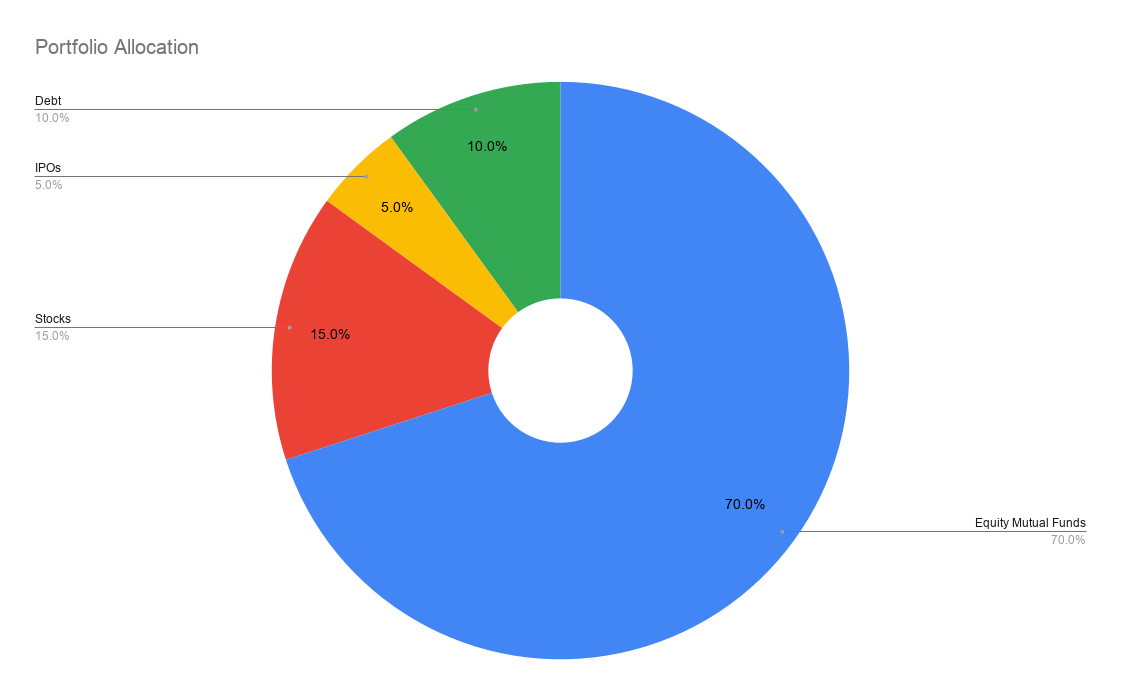
Illustrative portfolio allocation showing a growth-oriented approach for long-term wealth creation. Equity mutual funds form the core allocation, while stocks, IPOs, and debt investments play supporting roles. Actual allocation should depend on individual goals, risk tolerance, and investment horizon.
Common Mistakes to Avoid While Planning Early Retirement
So, now you know what investments can help you build sizable wealth to retire early. But they can only help you if you avoid the following mistakes.
Timing The Market & Panic Selling
You may see many courses on YouTube promising significant returns if you attend their courses. Just don't fall prey to them.
Don't start learning new trading strategies or option buying courses because they promise quick wealth. They are more likely to create a big hole in your retirement kitty.
Nobody can consistently time the market, not even legends like Warren Buffett.
There are always ups and downs in the market. We have seen events like the COVID-19 crash, the Russia-Ukraine war, and many other global events impact markets. They will never stop.
Don't change your investment strategy because of such events. If I had done that, I would have been wiped out during the COVID crash. Staying invested and following discipline rewarded me with much better returns.
And never panic sell. Panic selling often results in heavy losses and lifetime regrets. Choose good investments based on knowledge and stay invested for the long term.
Putting All Your Money Into Investments
Don't put all your money into stocks, mutual funds, or even debt funds if you may need that money in the next 2–3 years.
There may be a slowdown exactly when you need the money, and your investments could be in the red.
Invest only the money that you can afford to keep invested for the long term. And by long term, I mean 10+ years, not 2, 3, or even 5 years.
Reviewing The Portfolio Too Frequently
Keep reviewing your portfolio periodically, but don't make decisions in a hurry.
Once you have done good research or received good guidance to choose funds, give them at least 3 years to perform.
Also, don't fall prey to star ratings. They are dynamic and keep changing over time.
Learn Continuously
Legends say investing in yourself is the best investment. That is as true as the sun rises in the east.
Learn about mutual funds, stocks, fundamental analysis, GMPs, and IPOs.
You can also check our Mutual Fund Learning Hub, IPO Glossary, and IPO Analytics section to improve your knowledge and understanding.
Don't Keep More Investments Than You Can Analyse
Don't keep more stocks or mutual funds than you can review and analyse properly.
Try to maintain a concise portfolio. In this regard, I respect the advice of Peter Lynch, who said that if you choose enough stocks, one may surprise you, one may do very well, and others may be average.
The key is to own only those investments that you can continue reviewing and understanding.
Don't Follow Everybody's Advice
People often invest based on the advice of friends, colleagues, relatives, or random people rather than their own knowledge.
Avoid this completely.
Listen to others if you want, but make investment decisions based on your own understanding and research.
Step-by-Step Plan For Early Retirement
Step 1 — Track Expenses And Save As Much As You Can
Saving is the first step of your financial journey. So, plan ahead and save as much as you can.
And don't keep all your savings in a savings account. Park them in liquid funds.
Why do I suggest it?
Compare the returns of a good liquid fund, or even an average liquid fund, with the returns of a savings account.
So, don't spend everything. Save first so that you can invest.
Step 2 — Build An Emergency Fund
We all must have an emergency fund.
If you don't have one, start today and build it until you have 6–9 months of expenses saved.
It helps a lot and gives peace of mind during emergencies, so that you don't take decisions that you should completely avoid.
Step 3 — Don't Be In Debt
Like panic selling, unnecessary borrowing is another thing that can derail your early retirement plan.
So, don't rely on debt. Spend what you can afford. Don't try to show off.
Remember Warren Buffett's famous quote:
"If you buy things you don't need, soon you will sell things you need."
Step 4 — Start SIPs And Continue Them
SIPs build wealth, and I have experienced it myself.
If there were no SIPs, I probably would not have accumulated more than ₹1 crore within 11 years.
So, choose good funds and start your SIPs today.
Step 5 — Increase Income
Everyone wants a higher income, but not many people work on increasing it.
There are basically two ways. One is getting a raise through a promotion or by changing jobs. The second is learning skills that can help you earn more while continuing your job.
For example, blogging or vlogging.
Extra income helps you invest more, and when you invest more, your chances of retiring early increase as well.
Step 6 — Stay Invested During Crashes
As I already mentioned in the previous section, don't try to time the market because nobody can do it consistently.
Follow discipline and stay invested.
You are investing for retirement, not for panic selling during market crashes.
Step 7 — Increase Investments Whenever You Can
Whenever you get money to invest, don't wait. Set it aside for investments.
It could come from salary raises, bonuses, blogging, vlogging, or any other source of income.
These additional investments may look small today, but they can surprise you in the long run.
Conclusion:
Early retirement is not about becoming rich overnight. It is about building enough wealth through saving, investing, and discipline so that work becomes a choice rather than a necessity. Whether you start with ₹500 or ₹5,000, the most important step is to start today.
FAQ: How to Retire Early in India In 2026
1. Can I Retire Early In India?
Yes. I retired at 42 and for everyone early retirement is possible in India if you build a sufficient retirement corpus through disciplined saving, investing, and long-term wealth creation.
2. What Is The Best Age To Start Retirement Planning?
The best time to start retirement planning is when you receive your first salary. The earlier you start, the more time compounding gets to work for you.
3. How Much Money Do I Need To Retire Early In India?
There is no fixed number. The amount depends on your lifestyle, monthly expenses, inflation, retirement age, and expected investment returns. You can use our Retirement Calculator to estimate your retirement corpus.
4. Can Mutual Funds Help Me Retire Early?
Yes. Equity mutual funds have historically generated inflation-beating returns over long periods and can play a major role in building a retirement corpus. Even my mutual fund portfolio has given a 15+% CAGR.
5. Is SIP A Good Way To Plan For Early Retirement?
SIPs are one of the easiest ways to build wealth over time. They promote discipline and allow investors to benefit from long-term compounding.
6.Is ₹1 Crore Enough To Retire In India?
It depends on your age, expenses, location, and lifestyle. For some people it may be enough, while for others it may not be sufficient due to inflation and rising living costs. You can calculate in our retirement calculator whether it is enough for you or not.
7. Are IPOs Good For Retirement Planning?
IPOs can be a small part of a portfolio, but they should not be the core strategy for retirement planning. Long-term wealth creation generally requires disciplined investing over many years.
8. What Are The Biggest Mistakes In Retirement Planning?
Some common mistakes include delaying investments, ignoring inflation, timing the market, panic selling, taking excessive debt, and failing to build an emergency fund.
9. Is Inflation Really A Big Threat To Retirement Planning?
Yes. Inflation gradually reduces purchasing power over time. A lifestyle that costs ₹80,000 per month today may require more than ₹3 lakh per month after a couple of decades.
10. What Is The First Step Towards Early Retirement?
The first step is understanding your expenses, starting a savings habit, and creating a plan to invest regularly for the long term.
11. What Is The FIRE Movement?
FIRE stands for Financial Independence, Retire Early. It focuses on saving and investing aggressively so that individuals can achieve financial freedom much earlier than traditional retirement age.
12. How Often Should I Review My Retirement Portfolio?
A periodic review is important, but avoid making decisions based on short-term market movements. Long-term investing requires patience and discipline.
